Here, at the Top, is Where We Belong

At the beginning of this new year (2024), I had the chance to travel to our nation’s capital to meet new colleagues and do some good work. On the occasion of the 2024 Martin Luther King Jr. holiday, I was thrilled to be in the presence of many interesting people, especially beautiful black and brown people.

In particular, I met some beautiful black women, just like me, women of all ages who have made incredible contributions with their skills and intellect to the places and communities where they live. Most of them, younger than I, were super smart and quite capable.

Just as Harriet Tubman, Sojourner Truth, Fannie Lou Hamer, Pauli Murray, Alice Walker, Toni Morrison, Shirley Chisholm, Barbara Jordan, and many, many more gave of their time and talents, they are striving to make a difference with their labor. I could feel their power converge with mine.

All I could or can say, in the words of the R&B song, is keep “risin’ to the top.” Beautiful black women: keep doing good deeds. Use your voices and your skills to serve others, and act as co-creators on this place we call Earth. It was a total joy to be in the car with a younger, beautiful black woman and hear her say, “Is it okay if we listen to AfroPop?” Is it okay??? LET’S GO!!!

The world needs us beautiful black women; not to twerk or exploit our breathtaking features, but to assert and embrace the beauty of our humanity in a world that is littered by greed and selfish people who intentionally bring harm to the Earth and all its inhabitants.

Living in Kansas City, I do see many black men and black women in places of prominence, but unfortunately it seems to me that many do not want to embrace blackness as much as the generation before me once did (Baby Boomers). In other words, for some, “making it” or being successful in life or in one’s occupation has become synonymous with selecting a white spouse or partner; as a means for gaining social and economic validation or acceptance.

In Kansas City and beyond, it is not unusual for me to observe black Millennials, Gen Y’s, and Gen Z’s who aspire to look and be like Jennifer Aniston, Jennifer Lopez, or Brad Pitt, but not so much like Martin Luther King Jr. or Nina Simone. This is quite apparent to me when I turn on the local news. I am glad to see so many black journalists in the city, but the sound (voice) and appearance of them, in my opinion, culturally white, for the most part. Apart from skin color, cultural blackness, is not very apparent.

In professional circles, the ontology of blackness has historically been whitened or lightened “up” in order to be deemed beautiful or “appropriate” by the public. In social and professional circles, this is also apparent. Even when I am hanging out in the city I can see that many black women and men aspire to present themselves as culturally white and whitened; this is most articulated in day to day choices of apparel, and especially when it comes to the grooming of our hair. Likewise, we see the personal embrace of whiteness demonstrated in the choices that many black male professional sports players make off the field.

Historically, no one has wanted this dilution or accommodation of blackness more than those who are not black. I suppose this functions to make them feel better, more superior, about who they are. However, clearly this trend is changing in spite of the passage of more than a few “Crown Acts.” For example, today a black woman is often considered most beautiful if she has the bone straight, yet flowing hair of an alleged mermaid.

Hopefully, I do not need to remind you or anyone that the state of Missouri does not have the best track record as far as black people are concerned (as in the 1857 Dred Scott decision), and I am sensing it more and more – particularly in professional circles – where I do not see as many black women and men in Missouri who are at the top embracing and loving blackness, unapologetically, when they are at home, and with the partners they choose to share their beds.

I just took the time to watch the movie Killers of the Flower Moon, (all three and a half hours of it) and needless to say, the steady, gradual erasure of black cultural identity through eugenics or selective breeding has been a subject that has interested me for some time. I was heartbroken to learn how whites deceptively used marriage and relationships with indigenous Americans to gain economic and social wealth. Like many African Americans, I have roots with the indigenous people of this land and their descendants. Among other cultural influences, my paternal grandmother was unmistakably indigenous in appearance. Sadly, she was the only living grandparent that I ever knew.

Some black women and men might “talk black” all day, but that is about all that it is: TALK – because loving blackness is not what they do or practice at home. What they love, at home, is whiteness. Therefore, elevating and privileging white cultural identity is what appeals to them; the look and beauty of whiteness – or getting as close to the look of whiteness as possible – without embracing cultural and physical representations of blackness, is what they do. Aesthetics aside, this is also a type of “passing;” a way of gaining social and economic credibility (and benefits) through association or marriage.

When I see black women and men who are proud to be black and who are willing and able to love black people wholly and embrace cultural expressions of blackness, day and night, then I must acknowledge it. I intentionally take in “the blackness” (a lyric in a song from The Sounds of Blackness in the 1990’s) and the natural cultural characteristics and expressions of black people when I see us embrace ourselves and each other without feeling the need to replicate white standards of beauty or appearance.

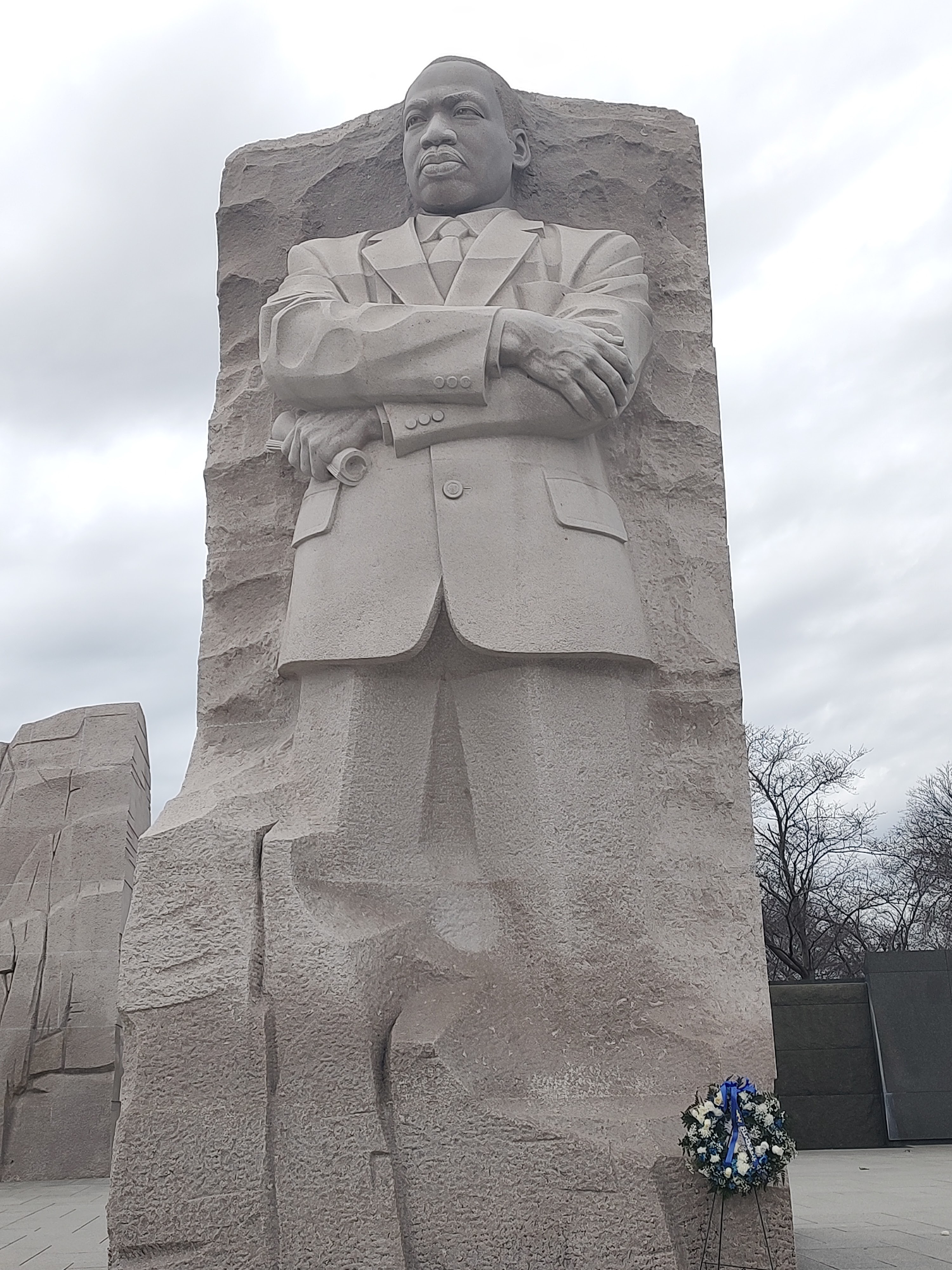
Before leaving Washington, D.C., a place that used be known as a sort of “Black Mecca” before Atlanta took first place, I took a long walk on the United States National Mall and stood silently for a moment in front of the monument as my 2024 tribute to Dr. Martin Luther King, Jr. I love that the sculptor gave Dr. King strong African physical features and expression – and that he emerges from the rock or the earth – even as he is wearing a suit, which is fashion or style created as an expression of white, European culture.

This April 2024, it will be fifty-six years since the assassination of the Rev. Dr. Martin Luther King, Jr., and as I stood there feeling the power of his image and the look on his face (pictured above), deep in my heart – or maybe it was coming from my Spotify playlist – I heard the lyrics to the song, “Risin’ to the Top.”

Risin’ to the Top, originally performed in 1988 by Keni Burke, was a jam that I definitely grooved to when I was an undergraduate student pursuing a degree in Political Science at the former Clark College, which was soon to be Clark Atlanta University. It has been sampled by quite a few musical artists, in particular Mary J. Blige.

Today, when I look around and see so many hateful, materialistic, and selfish black men and women operating in ways that tear themselves and others down, and making choices that keep them from experiencing happiness, it saddens me (and sometimes it rightly angers me). Is this us? Collectively, is this who we have become: devaluing and holding blackness in contempt like our oppressors did to our ancestors?

No, on this trip to Chocolate City, when I had the chance to talk with these beautiful black people and to perhaps make some new friends who are living out their lives with dedication to building themselves up and helping people in need, I was truly INSPIRED and once again proud to be who I am: A BLACK WOMAN.

Thank you, beautiful black people for reminding me and all of us of who we are, and of how important it is to “keep rising to the top, giving all we’ve got!”

Here, at the top, is where we definitely belong.

© 2024 annalise fonza, Ph.D., MURP, M.Div., MPA, BA

Updated 03/03/2025

Ending Emotional Manipulation

There is absolutely nothing wrong with putting an end to emotional manipulation and pain that have been caused by someone else’s reckless, selfish behavior.

If someone that you love is using your emotions to get something from you: such as attention, sex, money, praise, an escape from their fear of or inability to be alone, etc.,

They are not entitled to an explanation when you walk, or perhaps run away.

Close the door, protect yourself from the trauma and terror that they have allowed to define their lives and relationships.

Accept the fact that if they are doing this to you, intentionally, they are probably quite sick, in more ways than one.

They need help, but they will not help themselves; maybe they cannot help themselves, but you are not responsible for their healing.

You are responsible for your healing, for your well-being. With their abusiveness they have asked for you to turn away. They have insisted on your exit; to put an end to their intolerable and unacceptable actions, as far as you are concerned.

Make it impossible for them to even stand in your shadow. Do not be afraid to give them what they have asked for. Show them with your feet that there are consequences for hurting you.

Refuse to let them attempt to manipulate you any further or waste one minute of your precious time, or anything else that you might have to give them.

Open the door for love from someone who can and will show you that they truly know how to love themselves and others.

Be strong and courageous. Go on living and creating your beautiful life, and give yourself the compassion, love, and respect that they could never give to you.

You deserve it.

© 2024 annalise fonza, Ph.D., MURP, MDiv, MPA

“Who Do You Think You Are?” Look at Where You Come From

Hands down, one of the worst episodes that I experienced with a rageaholic happened on the telephone. One night, about 9:00pm, I received a call from a man that I loved and who claimed to love me. He asked me about my day.  As I began to share the events of my day, and expressed my disappointment about the delivery of an item that I had purchased online, he went into a rage. From out of nowhere he was yelling at me, repeating the words: WHO DO YOU THINK YOU ARE, WHO DO YOU THINK YOU ARE???

As he raised his voice, assaulting me with his words, I stopped talking in mid-sentence. I was totally stunned and mentally searching for a way to understand what in the world was going on. It was an episode that was terribly unexpected, uncalled for, exhausting, and traumatizing. His outburst was the last thing that I expected in that moment as he was clearly out-of-control and using his words and his “smartphone” to go off on me about an experience that had nothing to do with him. I was just sharing information, as requested, about my day.

The next morning he texted me to apologize, but the kicker was that he justified his yelling blaming it on “our lack of chemistry.” Not one word about a totally ambushing me emotionally with outrageous and unacceptable behavior caused by who knows what and by some very hostile, even hateful words aimed at me. Just days before, he told me how much he loved me, but yelling “WHO DO YOU THINK YOU ARE” for no reason at all is not how you show someone that you love them. Frankly, that tends to disqualify any claim of love, for me.

Indeed, I could not let him get away with acting like nothing obscene happened the night before. In response to his so-called apology, I simply texted back and rejected any claim that the incident had anything to do with me or with anything that I had done. In fact, the words that I used were: that was all you. As expected, there was no response, except for complete silence. He took absolutely no responsibility for his words and actions the previous night.

Nevertheless, I knew that I was not to blame for his unacceptable behavior. I was a victim of his words and actions, but I did not need to become victimized by his silence. What he was doing to me was totally incredible, but, sadly, it was a reflection of the hateful perceptions that he carried within himself about the person that he had become in response to the events of his life and as a result of his poor choices.

In the past several years, I have learned enough about addiction and alcoholism not to let a person who is struggling with his own identity or sense of self accuse me of not knowing mine. Under no circumstances would I or should I take responsibility for another person’s outrageous behavior, nor would I be an emotional punching bag for someone who was controlled by their fears and addictions.

Thankfully, I have learned how to give myself what I need when others break my heart or show me that they cannot or will not be kind to me or be there for me, emotionally or otherwise. It was a very troubling encounter, yet one that I will not allow myself to forget. Several years before the phone encounter, my friend admitted to me that he was a wounded man because of his experience with childhood trauma; in fact, the word he used to describe himself was “broken.” When I first heard him say this about himself, I did not want to believe him, but the more that I experienced him, the more I could understand how a person’s brokenness can cause problems for everyone with whom they come into contact. This is why it is important for those suffering from the memory of childhood trauma seek help in adulthood as they become able.

As I sought the help that I needed, I learned many valuable strategies and lessons that empowered me to respond, or not, to the toxicity of an emotionally abusive partner or entity. For instance, following the call, I allowed myself to acknowledge and feel the pain that he caused. I took the time to feel the trauma of his words move through my body; I did some stretches on my exercise mat; and then I made myself a cup of hot tea. As I sat down in silence, I took at least three long, deep breaths. In that moment, I grieved, and I was kind and loving to myself.

In that moment, I gave myself the compassion and permission to be deeply present to myself. This quiet, solitary exercise empowered me to embrace my feelings and own my feelings and thus my power in the moment, even as my assailant was no where to be found, nor did he seem to care. But I knew better than that: I knew that his silence was filled with his shame. Today, when I remember that incident, it still stings; still hurts, but I know what to do with the hurt when it comes to my awareness: I feel it, acknowledge it, and I send it back to where it came from

WHO DO YOU THINK YOU ARE?

I share this memory for two reasons: 1) because telling my story enables me to heal; and 2) as we head into a new year, I want to say that the words who do you think you are are significant for all of us.

When COVID-19 first made its onset, I remember saying to another friend, “Is the whole world going to shut down?” A few weeks later, it definitely seemed to me that the whole world was shutting down. Everything was changing, and super fast! As time went by, like everybody else I knew, I had to think long and hard about the shifts that were happening in plain sight. The world was changing, and sooner or later, we all had new and renewed ways of working, loving, and being.

As an urban planning academician, I teach courses about ethnic identity and the relationship it has to the history of place, as well as to the practice of urban planning. This year, I found myself emphasizing the intersectionality of identity, place and urban planning more than ever before. Currently, most of my students are non-white: they are predominantly Mexican-American or Asian-American, and I have structured the course to explore how specific narratives about cultural identity of black, brown, red, and yellow people, as it pertains to place, have emerged as a central aspect of placemaking in the U.S. Each of us has a cultural identity or heritage, which has everything to do with the expression of who we are, individually and collectively.

When I introduce my students to a concept that I and urban planning scholars call “emancipatory urban planning,” I reference the work of Dr. Gabor Maté. His recent best-selling book, The Myth of Normal: Trauma, Illness and Healing in a Toxic Culture is already a best-seller, and I am savoring every word. Yet, one of Dr. Maté’s best presentations with Diederik Wolsak and Sat Dharam Kaur ND, where they explore the importance of self-identity and self-awareness – is one of his best conversations online, as far as I am concerned. My takeaway is that if as individuals we think that we are worthy and valuable of love, then we will act that way: we will treat ourselves and others with compassion, love, and respect. On the other hand, if, deep down, we believe that we are not worthy of compassion, love, and respect, then we might mistreat ourselves and others, or we might rage and scream and point the finger at everyone else and make up all kinds of twisted and justifications for  out-of-control behaviors, just as described above.

I teach my students that before they go out into the world to work with communities as urban or regional planners, they must first know how to love, respect, and value themselves. In other words, before those of us who are in the business of sustaining communities and thus empowering others to be co-creators in making and remaking communities, we must know who we are and from whence we have come. We have to know and acknowledge our histories and cultural heritages, which are as different as we are. We are all human beings, but culturally, we are quite diverse. Becoming aware of our cultural heritages, and how they enable us to survive and even thrive in the world is essential for professional urban and regional planners. 

Over the years, I have endured terribly abusive verbal attacks by those who express hate or rejection of who I am (or how I self-identify) in various forms, including passive ones. In previous blog posts, I have written about the insults and verbal attacks that I have experienced by others because I identify as an atheist and as a womanist. Because our world is dominated by patriarchal and theistic thinking, many women, believe it or not, perpetuate patriarchal, theistic beliefs, consciously and subconsciously. Being on the receiving end of a woman who articulates toxic patriarchal ideas and norms is just as difficult as it is for me to be confronted by a black man who has internalized self-hate due to racist or white supremacist thinking and takes it out on me. Indeed, I have learned to anticipate hateful responses to my being an atheist and a womanist, yet because I anticipate them does not mean that I am comfortable with it when it happens.

At times, I must consider whether to take action against those who express hate or exclusion of me when they learn that I am an atheist. Sadly, there are times when I must take formal action to protect myself when people threaten to do harm to my person because I am a woman or for any other reason. There are some forms of disrespect and disregard that I simply do not tolerate. However, when my person or my mental health are not in danger or under threat, I have overcome abusive and hateful encounters by focusing on my breathing and on what I am feeling. Aside from the use of external assistance for protection from an abuser, like a restraining order, breathing has empowered me to keep my mental health in tact.

I am also usually willing to listen to others even with they have false or wrong perceptions, such as the false belief that an atheist does not have morals or has an alleged allegiance to an alleged being that is called “the devil”. For the record, I do not believe in any gods or supernatural beings, including the one that is called “the devil.” As long as it is clear to me that a person is not acting willfully to disrespect, devalue, or harm me, I am willing to entertain a conversation about what it means to be an atheist for the sake of definition. But, these interactions usually do not go much further than that.

I am very thankful for what I have learned about the power of mindful breathing from the teachings of Thich Nhat Hahn. A few years ago, I became intrigued by the Buddhist notion of the “bodhisattva.” A bodhisattva is more than an enlightened person. In the words of Thich Nhat Hahn, a bodhisattva is someone who “will allow another person to empty their heart,” even when that person has wrong perceptions or hurtful things to say. A couple of years ago, I began to incorporate the way of the bodhisattva in to my day-to-day interactions. When presented with the opportunity to listen, I allow the people that I love who intentionally make wrong or false things to empty their hearts, to an extent.

Everyone is not willing to aspire to be like a bodhisattva. Some could care less about listening to the pain and anger of their loved ones, but the more that I listened to Thich Nhat Hahn, the more I wanted to embrace bodhisattva practices. I wanted to listen to people that I cared about, even if what they said lacked validity or even truth, so that I could understand them. It was difficult at first, but learning to listening to others who express wrong or even angry perceptions – for the purpose of gaining an understanding – without trying to correct them nor taking responsibility for their thoughts – is an exercise in the power of love, which is the subject of my 2019 e-publication Rebuilding Black Communities, With Love.

As I continue to experience hate and rejection, I would rather be like the bodhisattva than anyone else. To some degree, I am even willing to listen to the pain of my loved ones, although they may refuse to listen to me, because sometimes it is just about being present, not about creating a teachable moment. Although I am an educator at heart, it is not always about education or agreement, rather there are times when assuring others that they have been heard is all that matters.

Perhaps, as Dr. Cornel West would say, I want to be like a “wounded healer, not like a wounded hurter,” because although repeatedly wounded or hurt or abandoned by many worldwide, black and brown people have taught the world how to heal, and we have done it through the unapologetic and authentic embrace of our heritage or cultural identity; through the creation of the literary and musical art forms such as the blues, jazz, and gospel music, for instance. Indeed, I have come from a people that have survived unthinkable hate and rejection simply because of the color of their skin, and yet have nonetheless created all kinds of beauty in the world.

There are many aspects of my cultural heritage that have enabled me to understand myself, even in the face of abuse or hate. In 2012, I published an essay in a peer-reviewed journal about the dialectical relationship between womanism and feminism in the planning profession, as I see it. In that article, I reference Alice Walker who asserted with her 2001 book, The Way Forward is with a Broken-Heart. As a woman who proudly identifies as black, I know first-hand how black people have experienced personal, social, and spatial heartache in a world that does not respect or value us. For instance, there are numerous black women writers and artists, such as Bernice Johnson Reagon and Toni Morrison, who lived with the pain of alienation caused by wrong perceptions of who they were and what they stood for. Yet, they moved through the heartache with mindful breathing and living, and sometimes without saying a mumbling word.

When I was in elementary school, I observed the elders in my life live mindfully and in silence. For a short while, one of my siblings and I walked a short distance (less than a mile) to the babysitter’s house everyday when school let out until our mother could come to pick us up when she got off work. My babysitter went by the name of Bachi (I have no idea how to spell it) and we called her husband, Granddad. Granddad was a chauffer for a living and they lived a quiet, simple life taking care of their children, grandchildren and other peoples’ children, like my siblings and me.

Bachi was very sweet to us; she always provided us with something good to eat (a habit that I tend to do whenever I have visitors). Granddad did not say very much; most of the time he moved without uttering one word, but he almost always managed to smile at us. When he arrived home daily, he sat in his chair amongst us (there was only one living room); and usually he fell asleep while we all sat and watched television. The memory of Bachi and Granddad is quite memorable to me because they taught me the importance of quiet dignity and the significance of living simply and with a sense of purpose. Their house was full of children and love.

When it is appropriate, and when my person is not in danger, I endeavor to employ the power of this type of self-lovingkindness. Breathing deeply and focusing on my inner peace or serenity is one way of tapping into the power of who I am. It is certainly what I do when I go for a daily two-mile walk or bike ride, which brings me back to the truth of who I am; these quiet moments do not make me think of a god or a higher power; they are acts that situate me at the center of my being, and they cause me to get in touch with all that has made me who I am.

Surely, there are times when I speak up and stand up for myself or others, but sometimes, I remind myself, that it is best to be like Bachi and Granddad and move in simplicity and silence using only my breath to remind myself of who I am. It may look like I am not doing much by breathing, but it is a powerful act of self-love if I am able to be wholly in the moment and totally aware of what is happening within – in the present moment. This gives me strength. Of course, there are times that my choice to breathe instead of responding with words may also be my way of letting others know that I have had enough. Choosing to act in this way – with mindful breathing and self-care – is one of the powerful ways that I have seen responsible adults and elders in my life manage painful moments and realities; breathing deeply is a practice that is inextricably tied my cultural heritage, or growing up as a black girl in what seemed like white America. Thankfully, I do not believe that this land belongs to any one group of any one group of people. In the words of Dr. Paul Ortiz, “the United States is a nation of ethnicities.”

If you have not done so already, I hope that you use this new year to come to a better understanding of who you are and where you came from. You can do this by looking at the way you value yourself and by the way that you treat others, everyday. If you were taught by the people who raised you to truly value and respect yourself and others, that will help you to answer the question who do you think you are? On the other hand, if you were taught to devalue yourself and others, that is probably who you will be, everyday, unless you do something – yourself – to change that, because who you think you are has an awful lot to do with where you come from, how you grew up, and of all the people and places that made you who you are today.

© 2023 annalise fonza, Ph.D., MURP, M.Div, MPA

Updated 09/18/2024
Please Don’t Tell Me You Love Me

Please don’t tell me you love me when you could care less about my feelings, my work, my life, my day, and my accomplishments,

Please don’t tell me you love me and you want to be with me, but you really don’t. That’s just what you say because you think I want to hear it,

Please don’t tell me you love me when you always run and hide behind your phone and all your other material possessions, especially when you know you have disappointed or hurt me,

Please don’t tell me you love me when you have rejected and scared away dang near every well-intentioned potential partner who has come into your life with deception and abuse,

Please don’t tell me you love me when you are more than willing to lie to get what you want or need (even when you don’t have to), and even when you know your lies will hurt others,

Please don’t tell me you love me when you constantly abandon yourself and the ones you claim to love (yet you cling to the ones, and the habits, that you claim to despise),

Please don’t tell me you love me when you destroy the love that we made with excessive drinking and anger that belong to a past that continues to define and control you,

Please don’t tell me that you love me when the only things that matter to you are your feelings, your work, your life, your day and your accomplishments,

Please don’t tell me you love me when you know that you are not the person that you say you are,

Please don’t tell me you love me when you are not willing to be honest and ask for the help that you know you desperately need, and for the help that will potentially bring you to what you need and want,

Please don’t tell me you love me until you can muster the strength and the courage to forgive yourself for hurting yourself and others,

Please, please don’t tell me whether I love you, or not, when clearly you do not even know how to love yourself.

©2019 annalise fonza, Ph.D.

Updated 12/19/2023

When Walking Away is All You Need to Say ‘NO’!

I learned how to walk away from troubled and abusive people in my life:

1) When the abuser chose to repeatedly lie, deceive and destroy the trust that we built and treasured,

2) When they claimed to be the victim of my actions (falsely alleging that I hurt their feelings) after they left me with no other option but to run away in order to protect myself (and all I have worked for) from their selfish actions, addictive behaviors and poor decisions,

3) When the person who abused me emotionally was a victim of abuse and emotional neglect as a child and (to this day) has chosen not to address their own woundedness with a mental health professional, although they have the means to do so,

4) When it dawned on me that the abandonment that I experienced from my abuser was a reenactment of the abandonment and abuse that they experienced in childhood, adolescence and, yes, even in adulthood,

5) When I had no other choice but to leave and thus stand up for the truth when my abuser cowardly made every attempt to barrage me with empty promises, meaningless excuses, and blatant omissions of truth,

6) When my abuser denied and refused to acknowledge the awful things they had done, claimed to be totally clueless about what they had done, and thus totally failed to be accountable for the emotional pain that they caused with their hateful actions, thoughts, and words,

7) And, when it became impossible to offer anything of value to them, especially my person, as it became apparent to me that the abuser would sabotage all the good that we worked for in our relationship with poor decision making, childish-narcissistic thinking, and addictive behaviors.

Indeed, in response to their traumatizing and terrifying behaviors, I could have become like an enemy or a ninja warrior to them, or I could have exposed them to others – even to law enforcement. Worse yet, I could have become just like my abuser, and just like their abusers whom they chose to emulate. But, without any doubt, walking away – which was made possible by standing up for myself and unapologetically in my truth – was the very best way to say ‘enough is enough‘: the number one way – in my book – to break the abusive cycle and get on with my amazing little life – because I do not have time to waste.

I believe that there are times when more drastic responses to abuse are appropriate (such as calling the police and filing charges), but there are times when it is enough to use our feet and our absence to say ABSOLUTELY NOT to those who intend to hurt us and then play the victim.

Freeing one’s self from an abusive, controlling, narcissistic person is a powerful act of self-expression and it requires courage: in the end it sends a bold message to the abuser that they did not have the control over you that they thought they had.

For those who choose to stay on the path of deceit, hate, and destruction, I need not to worry nor do I need to act for the purpose of revenge. They will inevitably do more harm to themselves than I or anyone else could ever do. On the one hand, hurt people, hurt people, and that is a horrible shame. Yet, most of all, hurt people hurt themselves because they abuse themselves by blocking themselves from being loved and cared for by healthy, well-meaning people. If they do not seek help to do something healthy to stop their pain, hurt people become their own worst enemies and eventually they might even self-destruct.

Finally, I have learned that hurt people who intentionally harm others tend to believe that they should get away with hurting people, perhaps because the people who hurt them got away with it. Unfortunately, that is not the way that it goes. Sometimes there are consequences to hurting people, and losing people is one of them.

© 2023 annalise fonza, Ph.D.

Updated 10/08/2023

Be Who You Are, Not What You Do

The things that I do for a living do not make me who I am. I work, primarily, so that I have money to pay my bills. On the one hand, my work is – to some degree – a reflection of who I am and what I value in life. On the other hand, and this is something that I believe we have all learned during the Coronavirus pandemic, is that work (as in a job) is temporal. It is time- sensitive and often limited by the environment in which we live, whether we understand that or not.

I know people who define themselves by the work that they do (or for more superficial reasons such as the benefits of work, i.e., money, prestige, power, material possessions). But what happens when that work dries up or goes away? Who would they be if their day-to-day work duties came to an end through no fault of their own, or through some fault of their own? It is good to take pride in our work, but it is even more important that we learn to define and express ourselves by what is within us, as opposed to what is outside or around us. And, we must know that who we are is not contingent upon what we do for a living, rather who we are is contingent on the beings that we are deep down inside.

There are people who I know in life who define themselves by the work that they do day-to-day on “the job.” Often, those very same people are workaholics, which is, as I have been told, one of the most acceptable yet destructive addictions that a person can have. Because, without that work, they feel meaningless, worthless, and very lost (in a world of so many possibilities). These very same people, who display so much pride and ego about their jobs may easily feel like nothing if and when their jobs come to a complete halt (and so do the things that that work provided). And, this should tell us something about their character, huh? Perhaps they lack the ability (or the courage) to reinvent themselves when life calls on them to create new ways of being and doing; and, unfortunately, that work and those things are what they use to define themselves. It does not have to be that way. 

In summary, who we are is connected to our character, which is an intangible thing and something that we develop over time, ever since the day that we came into this world. Are you a lover of trees or nature; are you a friend to the broken-hearted or the homeless; are you a fighter for peace and justice, or a natural-born leader? Are you a person who genuinely wants the good or advancement of others?

Or, are you only concerned about yourself and your earthly possessions? Do you misuse and abuse others? Is it easier for you to hate than to love? Of course, I know people who do not know who they are; or, they pretend that they are someone who they are not, usually to (cowardly) get what they want. These people do a lot of damage to themselves and to others.

Whoever you are, it is our character that will reveal who we are: good, bad, or in-between. To be sure, I do know some people who are genuinely good. That is, they are in touch with their own sense of self, which can exist on its own, apart from work, others, and the environments in which we live. Of course, character comes out in word, but most of all it is articulated in our deeds. Yes, the work that we do on a day-to-day basis may be a reflection of our character, or maybe it is not. It all depends on how and why that work is needed. Perhaps the work that we do today for ourselves simply sets the stage for what is to come later, or maybe the work we do today will last for a lifetime. Only you can be the judge and the jury for the place or value that work will take in your life. But, in times of uncertainty, it is always important to remember to be who you are, not what you do.

©2020 annalise fonza, Ph.D.

What Do You Believe?

What you believe about yourself and others will show up in your actions, not in your speech.

If you believe you are worthy, you will act like it and you will make the best choices that you can to experience the best that life has to offer.

If you believe that the lives of others are precious and free, you will treat them with kindness and respect.

If you believe that life is worth the living, you will live it to the best of your ability.

If you respect the people in your life, you will show them that you care about their lives and their feelings.

If you are a good person, you will say and do good things, and you will probably be a giver.

On the other hand, if you believe that you are not a good person, it will be articulated in your actions.

Perhaps you will sabotage just about every good thing that comes into your life, and then fail to take responsibility for the damage that you cause.

The malevolence of your beliefs about yourself will show up in your day-to-day living, and you will probably take much more than you give, if you give anything at all without any expectation of repayment.

If you are selfish, you will not care about how your actions affect others (and being selfish is not a sign that you love yourself, rather it is a type of greed or, frankly, narcissism).

If you are manipulative, you will lie and deceive others to get what you want, and even when what you want could be freely obtained or given.

If you are hateful, you will belittle and spew hate on to others, including those you do not even know. You will not be a genuinely pleasant person to be around.

If you are not trustworthy, you will not trust others, and you may always be looking over your shoulder, and weaponizing yourself with your words and actions.

If deep down you believe that you are not worthy of good things and good people, then you will choose things and people who are not good for you.

You will make poor choices, and possibly suffer devastating consequences.

Oh yes, I have learned to pay attention to the core beliefs of others (and to my own) by observing their actions, not their speech.

And doing this has taught me how to save my own life.

©2020 annalise fonza, Ph.D.

Updated: 07/27/2024

When You Are Loved

You will know when someone loves you and wants you in their life

When they make themselves present and available to you,

When they tell you about their day and how it went, but they also want to hear about you and your feelings;

They will want to be there for you, emotionally

Because the power of love makes room for reciprocity.

Most of all, when you are loved, they will show you that they care about you in word and in deed.

When you are loved, you will be a priority:

The first thing in the morning, and the last on their mind at night.

You will be to them like a light at the end of a dark tunnel,

Like an oasis in the middle of the desert or a dry place.

And, when you are loved, it will be hard to go for a day without you.

© 2019 annalise fonza, Ph.D.

You Are Worth It!

You are worth every pause that someone takes on your behalf.

You are worth every “ooh” and “aah” from a loved one or someone who is enamored by you.

You are worth every happy moment that you feel in your own life.

You are worth celebrating when something goes right, or when you get a new job.

You are worth all the smiles and kisses that your partner can send your way.

You are worth it when he or she stops what they are doing to come and see about you when you are scared, afraid, or in pain.

You are worth patience, compassion, and empathy, from your lover and friends.

You are worth a good listen to the stories that are buried deep within.

You are worth it when it means it will lessen the anxiety that you feel inside.

You are worth being heard.

You are worth being seen.

You are worth being valued and being made a priority by those who say they care about you.

You are worth it.

Say it to yourself – “I AM WORTH IT” – until you believe it, and

Never let anyone tell you that you are not worth their time or their attention.

However, in the event that someone shows you with their actions and their words that you are not worth anything to them,

When they show you that they could care less about what happens to you, or how you feel,

If they intentionally hurt you with their words and actions,

Then, please know, on the contrary, that they are not worthy of you or the love that you have to give,

And, more than likely, they are far too emotionally immature and unprepared to handle the ups and the downs of life,

With you.

© 2019 annalise fonza, Ph.D.