My First (Self-Published) Project is Now Available!

Thank you for taking the time to read my blog. Writing has become a central part of who I am and recently I published my first solo publication! You may find it by clicking on this link.

This brief e-publication, which is only available in digital format, will soon be available to library patrons as well. In addition, it is a womanist planning proposal, and it summarizes what I have learned (over the last twenty years) about the rebuilding of former black ghettos and predominantly black neighborhoods and communities in urban cities. It is both, a proposal and a love letter, as I reflect on the motivations and business legacy of Ollie Gates in Kansas City, Missouri.

It is also a book that I have dedicated to the memory of John Lee Johnson, who was a major catalytic force in redeveloping the North End of Champaign-Urbana, or an area where black residents of Champaign-Urbana were “allowed” to live. The North End is/was also spatially situated right across the street from the University of Illinois at Urbana-Champaign (UIUC). I had the privilege of following Mr. Johnson for about two years, when I was working on my master’s degree in urban and regional planning at UIUC. I learned so much from him, first-hand, about community and economic development.

If the development of former black ghettos, or predominantly black communities and neighborhoods is something that interests you, then this is definitely worth the read. And, it should not take you more than an hour to read it! I made it brief on purpose.

In addition, if you are someone who has supported my writing over the years, thank you, once again, for taking an interest in what I have to say. If you are new to this blog, then welcome to my world!

I look forward to publishing more in the future!

©2019 annalise fonza, Ph.D.

Why Aren’t You Famous?

A few years ago, a close friend who is now deceased, asked me one night, repeatedly, why aren’t you famous?

The truth is, I never wanted to be famous because fame comes with a price that I have never been willing to pay.

To be famous, I would have to be willing to open up my life a lot more than it already is. Famous people have to put up with a lot of b.s., and if they wish to remain famous, they have to people-please: much more than necessary if you ask me.

The thing that has mattered most to me in a little more than five and a half decades in this life is respect. To gain respect, all I have to do is get better and better at being me, with no apology.

So, the primary reason that I am not famous is that personal integrity is more valuable to me than keeping others happy, which is an illusion anyhow: and totally beyond my control.

Indeed, I am grateful to have come to such an important understanding.

Thank you for asking, my friend.

~annalise fonza, Ph.D., MURP, M.Div., MPA

© 07/08/2025

Respecting Aretha: Respecting Ourselves

In 2018, many of us watched as Bishop Charles Ellis touched Ariana Grande clearly without her consent, and other powerful men, twice her age, looked on, appeared too busy touching her in their minds to come to her rescue as she appeared uncomfortable and obviously trying to back away. In response to public outcry, Bishop Ellis offered an apology, but there are times when apologies don’t mean a damn thing, and not when someone has disrespected you and it has a double ripple effect.

In times like that, I know what will work because the “Queen of Soul,” Aretha Franklin taught us through her music. We can talk all day about what it is to be a queen, but to be a queen (or to live with a sense of pride and self-importance) is to behave or act like a queen. I believe that Ms. Franklin showed the world that there are times when a queen must DEMAND respect; without a doubt, there are times when women must muster the courage to stand up and respect themselves by being heard, whether it is popular or not.

In this world, where disrespect and hate, especially the hatred of women, also known as misogyny, are always lurking over us, there are moments when women MUST act, swiftly, powerfully, and make our voices heard. This is what some of us, who are brave, have done, time after time – yes, we women have done it. Historically, there have always been women who stood up boldly for themselves and others; they have raised their voices in word and deed. A true queen – a self-respecting woman – will stand up for herself and for her people, even when it is clear that the fight could be lost, or even when all the odds are against her. Because winning, or losing, is not the point, rather asserting our humanity, in spite of attempts to deny us this is often very necessary.

Whenever I stand up to someone, it is rarely about winning; rather it is always about making myself visible when someone has attempted to silence me, or make me invisible by asserting their power over me and depriving me of something that I am entitled to, such as the use of my own power, including the right to reject something or someone or their disrespecful behaviors, or the right to say no, the right to simply walk away from trauma or drama caused by someone else, or simply the right to be myself.

With her voice, the “Queen of Soul,” Aretha Franklin, courageously sang about how we women, and black women in particular, can make ourselves seen and heard; she taught us how to assert our humanity with our words and actions. She showed us, like so many other cultural ambassadors have done, like James Brown and many others, that in the face of blatant disrespect and mishandling, we must act.

Thus, to know respect, we must embrace it: say it, sing it, and most of all we must believe that we are worthy of respect. We must show and tell anyone in this world that respect is ours. It rightly belongs to us just as it belongs to men, and we deserve respect even if some dirty old you know who tries to diminish it, take it away from us, or act as if they are entitled to do whatever they want with us without consequences. Sometimes, it is imperative that we enable the consequences that those who have undeniably disrespected us have asked for.

I firmly believe that each of us has a duty to own and embrace the respect that we desire from others for ourselves, and sometimes, as Aretha Franklin once said, we must spell it out, R – E – S – P – E – C – T, because until we can embrace what respect actually means, for ourselves, as individuals, and collectively as women… ain’t nothing gonna change. If we do not stand up for ourselves we will get the same results we have been getting, which can be insane.

Therefore, when we articulate respect for ourselves, when we show our, friends, loved ones and even total strangers that we meet that it is their responsibility to “find out what it [respect] means” to us; when we make our boundaries clear and maintain those boundaries, when we stand up for ourselves and fight for ourselves and the dignity of our lives to be safe and at peace in our own kitchens,

In our bathrooms,
In our boardrooms,
In our bedrooms,
In our garages (thank you Marissa Alexander!),
In our conference rooms and classrooms,
In any of the rooms that we occupy, including courtrooms;

If we have anything to do with it, you better believe that there will be respect for the beautiful creatures that we are and much more than what we can do for others (especially as it pertains to the constant objectification and thus commodification of our bodies)!

For me, smack in the middle of my fifth decade, one that I proudly embrace because I have earned it and have done my best to live it to the fullest, I am convinced that when we refuse to accept the traumatic and violent unrequited advances that the world and others try to place on us in private AND in public; when we show respect for other brave women who have paved a way for us, such as Aretha, Ida, Maya, Harriet, Sojourner, bell, Octavia, Ava, and many women too many to mention, we affirm their courageous lives and we articulate the respect that we have for ourselves. Yes, sometimes showing respect for ourselves and thus showing up for ourselves comes with a heavy price, but it is always worth it.

Figuring this out was not easy, and certainly not when those disrespecting me were people who claimed to love and cherish me. Like many others, I had to learn for myself how to look past their words or even their intentions and insist upon actions that were respectful, in fact.

Today, if I had the opportunity to sit down with Ariana Grande and reflect on what happened to her in 2018 at the beautiful homegoing ceremony for Aretha Frankin, this is what I would say: My dear Ariana, you’ve got the mic and you’ve got the power. It is okay to use them as courageously as Aretha once did. Some of us are with you, but you must stand up for yourself. We cannot do it for you. But please remember, you are a celebrity, and this event happened for the world to see. Whatever you choose to do or not will show and teach us all how you expect to be respected, or not and that is what will be remembered.

© 2018 annalise fonza, Ph.D., MURP, M.Div., MPA

Updated 09/20/2024

“You’re Different:” And There Is Nothing Wrong With That!

When someone you love tells you “you’re different” so they can avoid taking responsibility for what they are doing, or not,

Give them what they cannot or will not do for themselves.

Do not allow the guilt they feel about being stuck in the choices that they have made, or not, hold you back from becoming a better, more beautiful you.

Change is central to who we are; we humans are made to grow. Change, evolution, and growth are a vital part of the human experience.

Those who refuse to change may find themselves to be like the walking dead, or, regrettably, they may soon wither and die because they did not prune themselves to make room for new growth.

When someone who you love tries to put you down for changing or growing; if they attempt to hurt you with abusive words and actions simply because you have decided to grow,

Make no apology for being yourself. Be Different.

There is absolutely nothing wrong with adapting to the curve balls that come in your life by endeavoring to become more healthy and responsible for yourself.

Don’t let the shame others feel about themselves be something you put on yourself. This is their dilemma, not yours.

You do not have to be like any and everybody else, especially not like those who are stuck in their self-destructive ways of being and in the inability to mature and become better humans.

Not to worry. In due time, the well that they dig for themselves with stubbornness, hatefulness, and inaction will be filled with that which they gave to this life.

© 2024 annalise fonza, Ph.D., MURP, M.Div., MPA

Updated 03/11/24

Excitement & Happiness

There is nothing like the feeling of knowing that someone gets excited just to:

Hear your voice,

Feel your touch,

Smell your pheromones,

See you smile.

Indeed, happiness is knowing that someone loves you just for who you are, and that they would do just about everything in their power to be with you.

It feels so very good to know, without any doubt, that you are important to someone else.

© 2024 annalise fonza, Ph.D., MURP, M.Div., MPA

No One Should Be Able to Love You Better Than You Can

I believe that I have learned an important lesson in how to heal from a painful situation or relationship (and it has only taken me more than half of my life to figure it out).

In my healing process, I had to learn to give myself all the feelings and attention that the people in my life could not give to me for one reason or another.

Who knew that being consistently and intentionally kind and loving to myself could become the most powerful way for me to truly heal from trauma or pain?

It sounds so simple, but when a person is in pain or when they are sad they often do not think that being kind to themselves is the answer. They just want the pain to go away.

They just want to feel better.

Once I learned how to start showing up for myself, emotionally, I began to acnowledge and understand my feelings, and my outer wounds begin to heal, one day at a time, as some might say.

I also learned that it was very important to resist the temptation to numb myself or do anything excessively, as a means for helping me cope with my feelings of sadness and loss.

Sadness and loss are just as much a part of life as happiness and gain, but many of us do not know how to manage sadness like we do happiness or joy. No one really teaches us head-on in childhood or adolescence how to work through sad and even negative feelings in ways that are loving and healthy, at least none that I remember. In my family of origin, for example, my siblings and I were each on our own when it came to feeling sadness and loss, especially as we all experienced the divorce of our parents and thus the loss of our family life as we knew it then. Nevertheless, I believe that we did the best we could with the tools that we had at the time.

In adulthood, as I heal from sad and painful situations, it has been critical for me to be more intentional about wading through my feelings. I take the time to feel and express my feelings, not to run from them or ignore them. I am a part of several support groups, and therefore I learn from others who are actively taking the time to recover their authentic selves.

On the other hand, I frequently seek out opportunities for solitude and self-reflection, and when I feel super low, I give myself all the feelings that I want and need from others, such as:

patience,

kindness,

recognition,

encouragement,

acceptance,

motivation,

praise,

unconditional love,

courage,

and of course the healing joy that comes from laughter.

Furthermore, since I am solo, there are many enjoyable activities that I do for and with myself, like listening to straight ahead jazz and professional message therapy, which bring me back to myself and to the task of making my dreams come true. I spend my energy on myself, instead of on others who have demonstrated to me that they do not give a flying-47 about me, my health, or my ultimate success in life.

As I practiced lovingkindness towards myself, I knew I was getting better when the memory of what others did or did not do did not matter to me as much as it once did. When I put the focus on just being me, in the words of the great Abbey Lincoln, I could tell that I was recollecting myself and my power. My strength was renewed as I learned to cultivate love and compassion into my very own being.

As a result, I have gained a profound realization of self-preservation; one that I never really had before. This understanding comes to me at the strangest of times, and when it does I remind that vulnerable and precious part of myself that I will do everything in my power to be here for her and to take care of her, to the best of my ability for the rest of my life.

Realizing the significance of self-advocacy is one of the greatest feelings that I have ever had: it has reassured me of the trustworthiness of my own persistence, power, and presence: my very own will to thrive. Sometimes, that looks like a fierce standing up for myself or protecting myself from those in my life who are unable to be there for me or from those who try to harm or hurt me. I have learned to trust myself, and I trust those who are trustworthy.

In today’s society, this type of vigilance is necessary because, increasingly, more people – all around the world – are exhibiting narcissistic and selfish traits. Regrettably, there are some very troubled people in this world and  they do cause others to feel pain and suffering, and I believe that the people who do this are very, very sick individuals. That is no excuse, but I do perceive them as immature and ill-minded people who function like badly behaving children. As adults, they are very dangerous people to be around because they often make impulsive, misguided decisions, but let them tell it  they are the victim of everyone else’s actions. They do not take accountability for what they do to hurt others nor do they seem to realize that they sabotage their own happiness. This is quite sad.

Anyhow, the moral of this blog is that unless you are sick or legitimately dependent upon others, no one should be able to love you (an adult) any better than you can. We can heal ourselves when we present ourselves with the gifts of lovingkindness.

© 2024 annalise fonza, Ph.D., MURP, M.Div., MPA

Updated 02/28/2024

Here, at the Top, is Where We Belong

At the beginning of this new year (2024), I had the chance to travel to our nation’s capital to meet new colleagues and do some good work. On the occasion of the 2024 Martin Luther King Jr. holiday, I was thrilled to be in the presence of many interesting people, especially beautiful black and brown people.

In particular, I met some beautiful black women, just like me, women of all ages who have made incredible contributions with their skills and intellect to the places and communities where they live. Most of them, younger than I, were super smart and quite capable.

Just as Harriet Tubman, Sojourner Truth, Fannie Lou Hamer, Pauli Murray, Alice Walker, Toni Morrison, Shirley Chisholm, Barbara Jordan, and many, many more gave of their time and talents, they are striving to make a difference with their labor. I could feel their power converge with mine.

All I could or can say, in the words of the R&B song, is keep “risin’ to the top.” Beautiful black women: keep doing good deeds. Use your voices and your skills to serve others, and act as co-creators on this place we call Earth. It was a total joy to be in the car with a younger, beautiful black woman and hear her say, “Is it okay if we listen to AfroPop?” Is it okay??? LET’S GO!!!

The world needs us beautiful black women; not to twerk or exploit our breathtaking features, but to assert and embrace the beauty of our humanity in a world that is littered by greed and selfish people who intentionally bring harm to the Earth and all its inhabitants.

Living in Kansas City, I do see many black men and black women in places of prominence, but unfortunately it seems to me that many do not want to embrace blackness as much as the generation before me once did (Baby Boomers). In other words, for some, “making it” or being successful in life or in one’s occupation has become synonymous with selecting a white spouse or partner; as a means for gaining social and economic validation or acceptance.

In Kansas City and beyond, it is not unusual for me to observe black Millennials, Gen Y’s, and Gen Z’s who aspire to look and be like Jennifer Aniston, Jennifer Lopez, or Brad Pitt, but not so much like Martin Luther King Jr. or Nina Simone. This is quite apparent to me when I turn on the local news. I am glad to see so many black journalists in the city, but the sound (voice) and appearance of them, in my opinion, culturally white, for the most part. Apart from skin color, cultural blackness, is not very apparent.

In professional circles, the ontology of blackness has historically been whitened or lightened “up” in order to be deemed beautiful or “appropriate” by the public. In social and professional circles, this is also apparent. Even when I am hanging out in the city I can see that many black women and men aspire to present themselves as culturally white and whitened; this is most articulated in day to day choices of apparel, and especially when it comes to the grooming of our hair. Likewise, we see the personal embrace of whiteness demonstrated in the choices that many black male professional sports players make off the field.

Historically, no one has wanted this dilution or accommodation of blackness more than those who are not black. I suppose this functions to make them feel better, more superior, about who they are. However, clearly this trend is changing in spite of the passage of more than a few “Crown Acts.” For example, today a black woman is often considered most beautiful if she has the bone straight, yet flowing hair of an alleged mermaid.

Hopefully, I do not need to remind you or anyone that the state of Missouri does not have the best track record as far as black people are concerned (as in the 1857 Dred Scott decision), and I am sensing it more and more – particularly in professional circles – where I do not see as many black women and men in Missouri who are at the top embracing and loving blackness, unapologetically, when they are at home, and with the partners they choose to share their beds.

I just took the time to watch the movie Killers of the Flower Moon, (all three and a half hours of it) and needless to say, the steady, gradual erasure of black cultural identity through eugenics or selective breeding has been a subject that has interested me for some time. I was heartbroken to learn how whites deceptively used marriage and relationships with indigenous Americans to gain economic and social wealth. Like many African Americans, I have roots with the indigenous people of this land and their descendants. Among other cultural influences, my paternal grandmother was unmistakably indigenous in appearance. Sadly, she was the only living grandparent that I ever knew.

Some black women and men might “talk black” all day, but that is about all that it is: TALK – because loving blackness is not what they do or practice at home. What they love, at home, is whiteness. Therefore, elevating and privileging white cultural identity is what appeals to them; the look and beauty of whiteness – or getting as close to the look of whiteness as possible – without embracing cultural and physical representations of blackness, is what they do. Aesthetics aside, this is also a type of “passing;” a way of gaining social and economic credibility (and benefits) through association or marriage.

When I see black women and men who are proud to be black and who are willing and able to love black people wholly and embrace cultural expressions of blackness, day and night, then I must acknowledge it. I intentionally take in “the blackness” (a lyric in a song from The Sounds of Blackness in the 1990’s) and the natural cultural characteristics and expressions of black people when I see us embrace ourselves and each other without feeling the need to replicate white standards of beauty or appearance.

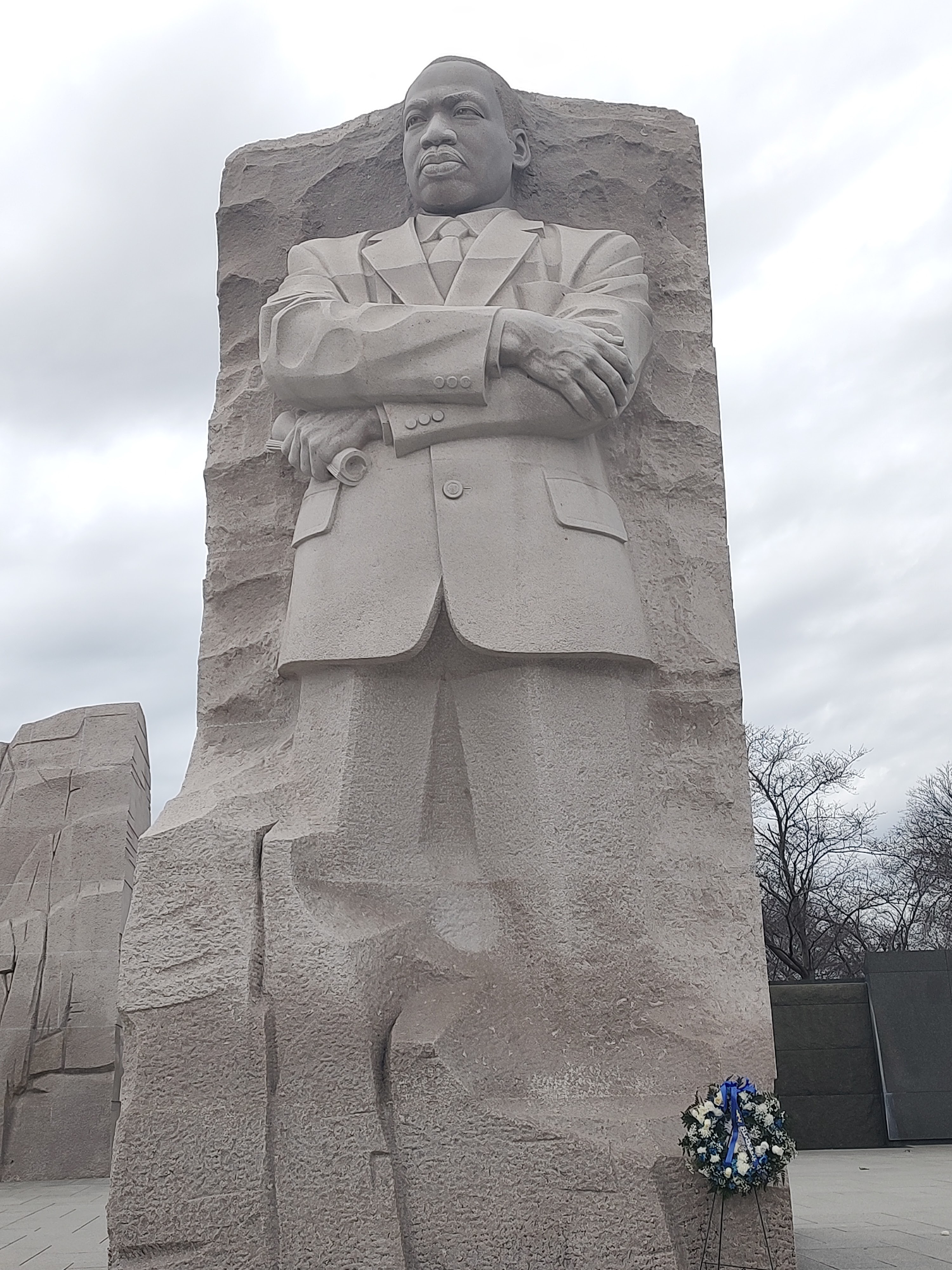
Before leaving Washington, D.C., a place that used be known as a sort of “Black Mecca” before Atlanta took first place, I took a long walk on the United States National Mall and stood silently for a moment in front of the monument as my 2024 tribute to Dr. Martin Luther King, Jr. I love that the sculptor gave Dr. King strong African physical features and expression – and that he emerges from the rock or the earth – even as he is wearing a suit, which is fashion or style created as an expression of white, European culture.

This April 2024, it will be fifty-six years since the assassination of the Rev. Dr. Martin Luther King, Jr., and as I stood there feeling the power of his image and the look on his face (pictured above), deep in my heart – or maybe it was coming from my Spotify playlist – I heard the lyrics to the song, “Risin’ to the Top.”

Risin’ to the Top, originally performed in 1988 by Keni Burke, was a jam that I definitely grooved to when I was an undergraduate student pursuing a degree in Political Science at the former Clark College, which was soon to be Clark Atlanta University. It has been sampled by quite a few musical artists, in particular Mary J. Blige.

Today, when I look around and see so many hateful, materialistic, and selfish black men and women operating in ways that tear themselves and others down, and making choices that keep them from experiencing happiness, it saddens me (and sometimes it rightly angers me). Is this us? Collectively, is this who we have become: devaluing and holding blackness in contempt like our oppressors did to our ancestors?

No, on this trip to Chocolate City, when I had the chance to talk with these beautiful black people and to perhaps make some new friends who are living out their lives with dedication to building themselves up and helping people in need, I was truly INSPIRED and once again proud to be who I am: A BLACK WOMAN.

Thank you, beautiful black people for reminding me and all of us of who we are, and of how important it is to “keep rising to the top, giving all we’ve got!”

Here, at the top, is where we definitely belong.

© 2024 annalise fonza, Ph.D., MURP, M.Div., MPA, BA

Updated 03/03/2025

Ending Emotional Manipulation

There is absolutely nothing wrong with putting an end to emotional manipulation and pain that have been caused by someone else’s reckless, selfish behavior.

If someone that you love is using your emotions to get something from you: such as attention, sex, money, praise, an escape from their fear of or inability to be alone, etc.,

They are not entitled to an explanation when you walk, or perhaps run away.

Close the door, protect yourself from the trauma and terror that they have allowed to define their lives and relationships.

Accept the fact that if they are doing this to you, intentionally, they are probably quite sick, in more ways than one.

They need help, but they will not help themselves; maybe they cannot help themselves, but you are not responsible for their healing.

You are responsible for your healing, for your well-being. With their abusiveness they have asked for you to turn away. They have insisted on your exit; to put an end to their intolerable and unacceptable actions, as far as you are concerned.

Make it impossible for them to even stand in your shadow. Do not be afraid to give them what they have asked for. Show them with your feet that there are consequences for hurting you.

Refuse to let them attempt to manipulate you any further or waste one minute of your precious time, or anything else that you might have to give them.

Open the door for love from someone who can and will show you that they truly know how to love themselves and others.

Be strong and courageous. Go on living and creating your beautiful life, and give yourself the compassion, love, and respect that they could never give to you.

You deserve it.

© 2024 annalise fonza, Ph.D., MURP, MDiv, MPA

“Who Do You Think You Are?” Look at Where You Come From

Hands down, one of the worst episodes that I experienced with a rageaholic happened on the telephone. One night, about 9:00pm, I received a call from a man that I loved and who claimed to love me. He asked me about my day.  As I began to share the events of my day, and expressed my disappointment about the delivery of an item that I had purchased online, he went into a rage. From out of nowhere he was yelling at me, repeating the words: WHO DO YOU THINK YOU ARE, WHO DO YOU THINK YOU ARE???

As he raised his voice, assaulting me with his words, I stopped talking in mid-sentence. I was totally stunned and mentally searching for a way to understand what in the world was going on. It was an episode that was terribly unexpected, uncalled for, exhausting, and traumatizing. His outburst was the last thing that I expected in that moment as he was clearly out-of-control and using his words and his “smartphone” to go off on me about an experience that had nothing to do with him. I was just sharing information, as requested, about my day.

The next morning he texted me to apologize, but the kicker was that he justified his yelling blaming it on “our lack of chemistry.” Not one word about a totally ambushing me emotionally with outrageous and unacceptable behavior caused by who knows what and by some very hostile, even hateful words aimed at me. Just days before, he told me how much he loved me, but yelling “WHO DO YOU THINK YOU ARE” for no reason at all is not how you show someone that you love them. Frankly, that tends to disqualify any claim of love, for me.

Indeed, I could not let him get away with acting like nothing obscene happened the night before. In response to his so-called apology, I simply texted back and rejected any claim that the incident had anything to do with me or with anything that I had done. In fact, the words that I used were: that was all you. As expected, there was no response, except for complete silence. He took absolutely no responsibility for his words and actions the previous night.

Nevertheless, I knew that I was not to blame for his unacceptable behavior. I was a victim of his words and actions, but I did not need to become victimized by his silence. What he was doing to me was totally incredible, but, sadly, it was a reflection of the hateful perceptions that he carried within himself about the person that he had become in response to the events of his life and as a result of his poor choices.

In the past several years, I have learned enough about addiction and alcoholism not to let a person who is struggling with his own identity or sense of self accuse me of not knowing mine. Under no circumstances would I or should I take responsibility for another person’s outrageous behavior, nor would I be an emotional punching bag for someone who was controlled by their fears and addictions.

Thankfully, I have learned how to give myself what I need when others break my heart or show me that they cannot or will not be kind to me or be there for me, emotionally or otherwise. It was a very troubling encounter, yet one that I will not allow myself to forget. Several years before the phone encounter, my friend admitted to me that he was a wounded man because of his experience with childhood trauma; in fact, the word he used to describe himself was “broken.” When I first heard him say this about himself, I did not want to believe him, but the more that I experienced him, the more I could understand how a person’s brokenness can cause problems for everyone with whom they come into contact. This is why it is important for those suffering from the memory of childhood trauma seek help in adulthood as they become able.

As I sought the help that I needed, I learned many valuable strategies and lessons that empowered me to respond, or not, to the toxicity of an emotionally abusive partner or entity. For instance, following the call, I allowed myself to acknowledge and feel the pain that he caused. I took the time to feel the trauma of his words move through my body; I did some stretches on my exercise mat; and then I made myself a cup of hot tea. As I sat down in silence, I took at least three long, deep breaths. In that moment, I grieved, and I was kind and loving to myself.

In that moment, I gave myself the compassion and permission to be deeply present to myself. This quiet, solitary exercise empowered me to embrace my feelings and own my feelings and thus my power in the moment, even as my assailant was no where to be found, nor did he seem to care. But I knew better than that: I knew that his silence was filled with his shame. Today, when I remember that incident, it still stings; still hurts, but I know what to do with the hurt when it comes to my awareness: I feel it, acknowledge it, and I send it back to where it came from

WHO DO YOU THINK YOU ARE?

I share this memory for two reasons: 1) because telling my story enables me to heal; and 2) as we head into a new year, I want to say that the words who do you think you are are significant for all of us.

When COVID-19 first made its onset, I remember saying to another friend, “Is the whole world going to shut down?” A few weeks later, it definitely seemed to me that the whole world was shutting down. Everything was changing, and super fast! As time went by, like everybody else I knew, I had to think long and hard about the shifts that were happening in plain sight. The world was changing, and sooner or later, we all had new and renewed ways of working, loving, and being.

As an urban planning academician, I teach courses about ethnic identity and the relationship it has to the history of place, as well as to the practice of urban planning. This year, I found myself emphasizing the intersectionality of identity, place and urban planning more than ever before. Currently, most of my students are non-white: they are predominantly Mexican-American or Asian-American, and I have structured the course to explore how specific narratives about cultural identity of black, brown, red, and yellow people, as it pertains to place, have emerged as a central aspect of placemaking in the U.S. Each of us has a cultural identity or heritage, which has everything to do with the expression of who we are, individually and collectively.

When I introduce my students to a concept that I and urban planning scholars call “emancipatory urban planning,” I reference the work of Dr. Gabor Maté. His recent best-selling book, The Myth of Normal: Trauma, Illness and Healing in a Toxic Culture is already a best-seller, and I am savoring every word. Yet, one of Dr. Maté’s best presentations with Diederik Wolsak and Sat Dharam Kaur ND, where they explore the importance of self-identity and self-awareness – is one of his best conversations online, as far as I am concerned. My takeaway is that if as individuals we think that we are worthy and valuable of love, then we will act that way: we will treat ourselves and others with compassion, love, and respect. On the other hand, if, deep down, we believe that we are not worthy of compassion, love, and respect, then we might mistreat ourselves and others, or we might rage and scream and point the finger at everyone else and make up all kinds of twisted and justifications for  out-of-control behaviors, just as described above.

I teach my students that before they go out into the world to work with communities as urban or regional planners, they must first know how to love, respect, and value themselves. In other words, before those of us who are in the business of sustaining communities and thus empowering others to be co-creators in making and remaking communities, we must know who we are and from whence we have come. We have to know and acknowledge our histories and cultural heritages, which are as different as we are. We are all human beings, but culturally, we are quite diverse. Becoming aware of our cultural heritages, and how they enable us to survive and even thrive in the world is essential for professional urban and regional planners. 

Over the years, I have endured terribly abusive verbal attacks by those who express hate or rejection of who I am (or how I self-identify) in various forms, including passive ones. In previous blog posts, I have written about the insults and verbal attacks that I have experienced by others because I identify as an atheist and as a womanist. Because our world is dominated by patriarchal and theistic thinking, many women, believe it or not, perpetuate patriarchal, theistic beliefs, consciously and subconsciously. Being on the receiving end of a woman who articulates toxic patriarchal ideas and norms is just as difficult as it is for me to be confronted by a black man who has internalized self-hate due to racist or white supremacist thinking and takes it out on me. Indeed, I have learned to anticipate hateful responses to my being an atheist and a womanist, yet because I anticipate them does not mean that I am comfortable with it when it happens.

At times, I must consider whether to take action against those who express hate or exclusion of me when they learn that I am an atheist. Sadly, there are times when I must take formal action to protect myself when people threaten to do harm to my person because I am a woman or for any other reason. There are some forms of disrespect and disregard that I simply do not tolerate. However, when my person or my mental health are not in danger or under threat, I have overcome abusive and hateful encounters by focusing on my breathing and on what I am feeling. Aside from the use of external assistance for protection from an abuser, like a restraining order, breathing has empowered me to keep my mental health in tact.

I am also usually willing to listen to others even with they have false or wrong perceptions, such as the false belief that an atheist does not have morals or has an alleged allegiance to an alleged being that is called “the devil”. For the record, I do not believe in any gods or supernatural beings, including the one that is called “the devil.” As long as it is clear to me that a person is not acting willfully to disrespect, devalue, or harm me, I am willing to entertain a conversation about what it means to be an atheist for the sake of definition. But, these interactions usually do not go much further than that.

I am very thankful for what I have learned about the power of mindful breathing from the teachings of Thich Nhat Hahn. A few years ago, I became intrigued by the Buddhist notion of the “bodhisattva.” A bodhisattva is more than an enlightened person. In the words of Thich Nhat Hahn, a bodhisattva is someone who “will allow another person to empty their heart,” even when that person has wrong perceptions or hurtful things to say. A couple of years ago, I began to incorporate the way of the bodhisattva in to my day-to-day interactions. When presented with the opportunity to listen, I allow the people that I love who intentionally make wrong or false things to empty their hearts, to an extent.

Everyone is not willing to aspire to be like a bodhisattva. Some could care less about listening to the pain and anger of their loved ones, but the more that I listened to Thich Nhat Hahn, the more I wanted to embrace bodhisattva practices. I wanted to listen to people that I cared about, even if what they said lacked validity or even truth, so that I could understand them. It was difficult at first, but learning to listening to others who express wrong or even angry perceptions – for the purpose of gaining an understanding – without trying to correct them nor taking responsibility for their thoughts – is an exercise in the power of love, which is the subject of my 2019 e-publication Rebuilding Black Communities, With Love.

As I continue to experience hate and rejection, I would rather be like the bodhisattva than anyone else. To some degree, I am even willing to listen to the pain of my loved ones, although they may refuse to listen to me, because sometimes it is just about being present, not about creating a teachable moment. Although I am an educator at heart, it is not always about education or agreement, rather there are times when assuring others that they have been heard is all that matters.

Perhaps, as Dr. Cornel West would say, I want to be like a “wounded healer, not like a wounded hurter,” because although repeatedly wounded or hurt or abandoned by many worldwide, black and brown people have taught the world how to heal, and we have done it through the unapologetic and authentic embrace of our heritage or cultural identity; through the creation of the literary and musical art forms such as the blues, jazz, and gospel music, for instance. Indeed, I have come from a people that have survived unthinkable hate and rejection simply because of the color of their skin, and yet have nonetheless created all kinds of beauty in the world.

There are many aspects of my cultural heritage that have enabled me to understand myself, even in the face of abuse or hate. In 2012, I published an essay in a peer-reviewed journal about the dialectical relationship between womanism and feminism in the planning profession, as I see it. In that article, I reference Alice Walker who asserted with her 2001 book, The Way Forward is with a Broken-Heart. As a woman who proudly identifies as black, I know first-hand how black people have experienced personal, social, and spatial heartache in a world that does not respect or value us. For instance, there are numerous black women writers and artists, such as Bernice Johnson Reagon and Toni Morrison, who lived with the pain of alienation caused by wrong perceptions of who they were and what they stood for. Yet, they moved through the heartache with mindful breathing and living, and sometimes without saying a mumbling word.

When I was in elementary school, I observed the elders in my life live mindfully and in silence. For a short while, one of my siblings and I walked a short distance (less than a mile) to the babysitter’s house everyday when school let out until our mother could come to pick us up when she got off work. My babysitter went by the name of Bachi (I have no idea how to spell it) and we called her husband, Granddad. Granddad was a chauffer for a living and they lived a quiet, simple life taking care of their children, grandchildren and other peoples’ children, like my siblings and me.

Bachi was very sweet to us; she always provided us with something good to eat (a habit that I tend to do whenever I have visitors). Granddad did not say very much; most of the time he moved without uttering one word, but he almost always managed to smile at us. When he arrived home daily, he sat in his chair amongst us (there was only one living room); and usually he fell asleep while we all sat and watched television. The memory of Bachi and Granddad is quite memorable to me because they taught me the importance of quiet dignity and the significance of living simply and with a sense of purpose. Their house was full of children and love.

When it is appropriate, and when my person is not in danger, I endeavor to employ the power of this type of self-lovingkindness. Breathing deeply and focusing on my inner peace or serenity is one way of tapping into the power of who I am. It is certainly what I do when I go for a daily two-mile walk or bike ride, which brings me back to the truth of who I am; these quiet moments do not make me think of a god or a higher power; they are acts that situate me at the center of my being, and they cause me to get in touch with all that has made me who I am.

Surely, there are times when I speak up and stand up for myself or others, but sometimes, I remind myself, that it is best to be like Bachi and Granddad and move in simplicity and silence using only my breath to remind myself of who I am. It may look like I am not doing much by breathing, but it is a powerful act of self-love if I am able to be wholly in the moment and totally aware of what is happening within – in the present moment. This gives me strength. Of course, there are times that my choice to breathe instead of responding with words may also be my way of letting others know that I have had enough. Choosing to act in this way – with mindful breathing and self-care – is one of the powerful ways that I have seen responsible adults and elders in my life manage painful moments and realities; breathing deeply is a practice that is inextricably tied my cultural heritage, or growing up as a black girl in what seemed like white America. Thankfully, I do not believe that this land belongs to any one group of any one group of people. In the words of Dr. Paul Ortiz, “the United States is a nation of ethnicities.”

If you have not done so already, I hope that you use this new year to come to a better understanding of who you are and where you came from. You can do this by looking at the way you value yourself and by the way that you treat others, everyday. If you were taught by the people who raised you to truly value and respect yourself and others, that will help you to answer the question who do you think you are? On the other hand, if you were taught to devalue yourself and others, that is probably who you will be, everyday, unless you do something – yourself – to change that, because who you think you are has an awful lot to do with where you come from, how you grew up, and of all the people and places that made you who you are today.

© 2023 annalise fonza, Ph.D., MURP, M.Div, MPA

Updated 09/18/2024
When You’ve Earned It, The Sweetness Belongs to You

I did a lot of things – big and small – to get to where I am today. For example, I have worked jobs where I have been underemployed and overqualified. Regardless, I never doubted where I could or would be. I have always believed in myself and my ability to be the best that I can be in life.

Unfortunately, I have known a number of people who doubted me and what lay ahead for me. They have been long gone. I also have known a few that tried to sabotage the foundation of the relationship that we had. They too have been gone, even long before they were out of my life. Finally, there we some people who came into my life who were clueless about me and what I was capable of, and they totally missed me. I can count on one hand the number of people who truly “got me” or who believed in me and who demonstrated that they were more than willing to help me get where I was trying to go. I have walked alone most of the time, but I would not have made it to where I am today without the help and encouragement of those who did their best to stand by me (as opposed to the ones who made a habit of lying to me and walking out on me).

A few of my naysayers, however, really stand out. Not too long ago, one of my former managers, told me that if I wanted the answer to a certain question about the work that I was doing, that I should go and “raise my pay grade.” How I would love to run into that manager today and say, “Guess what, boo, I raised my pay grade!” Would that be petty? Oh well, I digress.

Once, a former partner asked me why I had never been married, and my answer to that was simply this: most of the men that I knew intimately did not have the ability to wait. In addition, a lot of them (men) really sucked at grinding or putting in the necessary time and work that it takes for two people to be in a healthy relationship, not to mention what it takes for an individual or a couple to get from one level to the next.

The majority of my former partners were very impatient and wanted things to happen on their timetable. On the other hand, they did not have good healthy examples – in childhood or adolescence – of how to sustain a healthy, intimate relationship. When it came to my affairs, and to our relationship, they wanted that instant gratification: forget putting in work or actively working things out with give and take. I believe a few approached relationship with me as best as they could, but most ofy former partners relied on that old school logic (where the man controls, dominates, calls the shots). Most of all, they lacked integrity and communication skills. They lived by that old school “my way or the highway” approach, and that did not work out too well with me. From childhood, I was always a very independent person. I am so glad that I had sense enough to keep it moving, not to settle on mediocrity or dysfunction because that is what is out there these days, in abundance: those stuck in the past and reliving their parents’ lives. People who do this tolerate dysfunction and toxicity so much that they think it is normal. On the contrary, I strive for excellence in everything I do. I refuse to put up with the bullcrap, and I am moving forward, not backwards. I do not want to repeat the mistakes of the past.

Looking in the rear view mirror, one of the most important lessons that I have learned is that there is nothing like earning my “just desserts.” Undoubtedly, this world is full of people who do not earn it: the richest of the rich inherit it. They get lucky. Their inheritance is handed to them, or they were simply in the right place at the right time, or born into it. By and large, today’s up and coming tend to buy success. They buy what they want and get immediate results, sometimes overnight. Perhaps there are times when overnight results or overnight success is advisable; there are always situations where we do not have to wait; and there is certainly nothing wrong with experiencing a little instant luck from time to time. But, cultivating fortitude, or developing the ability to wait on good times and good people to come into our lives takes skill, and it is definitely worth the wait. I can attest that there is some truth to the saying, “Good things come to those who wait.”

If you are a person who wants their rewards right here, right now, it is important to be aware that it will probably not work out as planned, no matter how much money you have, or no matter what you do. Sometimes we have to put in a significant amount of work and time if we want to reach our goals or be successful, and with our honor still in tact. There were many times that I could have settled for what was presented to me in the moment; I could have settled for “Mr. Right Now.” But, the longer that I waited on my highest good to come in to my life, the more I could see that which was not my highest good, or that which would keep me from reaching my highest good: the more clarity that I gained.

Recently, one of my friends said to me, “Everybody gets their turn in life,” and there is clearly some truth to that. Each of us has something to get and something to give in life, and sometimes what we get – right away – is really good. Speaking from experience, however, it is clear to me that that which comes fast or quick, often does not last, nor do the people who come with it. I have met a lot of people who would not and did not stick around when the going got pretty rough for me; they (including friends, families, lovers) were not able to be fully present. They were only willing to be present to me in the “good times.” So, sadly, as the old adage goes, “easy come, easy go.”

Nevertheless, when the tables turn and life seems to open up, there is nothing like that feeling, especially when you have earned it with blood, sweat, and tears. When that happens, when every part of the wait and the heartache proves worth it, and you are on the path you have always wanted to be on because you put in the time and necessary work so that you could freely be on that road, there is absolutely, positively, no turning back to the way things used to be. When that happens, the only way to go is forward and to enjoy the fruit of your labor – and all by yourself if you have to. Because when you have earned it, no one deserves to savor the sweetness that life has to offer more than you do.

© 2023 annalise fonza, Ph.D., MURP, M.Div, MPA

Updated 12/27/2023

Please Don’t Tell Me You Love Me

Please don’t tell me you love me when you could care less about my feelings, my work, my life, my day, and my accomplishments,

Please don’t tell me you love me and you want to be with me, but you really don’t. That’s just what you say because you think I want to hear it,

Please don’t tell me you love me when you always run and hide behind your phone and all your other material possessions, especially when you know you have disappointed or hurt me,

Please don’t tell me you love me when you have rejected and scared away dang near every well-intentioned potential partner who has come into your life with deception and abuse,

Please don’t tell me you love me when you are more than willing to lie to get what you want or need (even when you don’t have to), and even when you know your lies will hurt others,

Please don’t tell me you love me when you constantly abandon yourself and the ones you claim to love (yet you cling to the ones, and the habits, that you claim to despise),

Please don’t tell me you love me when you destroy the love that we made with excessive drinking and anger that belong to a past that continues to define and control you,

Please don’t tell me that you love me when the only things that matter to you are your feelings, your work, your life, your day and your accomplishments,

Please don’t tell me you love me when you know that you are not the person that you say you are,

Please don’t tell me you love me when you are not willing to be honest and ask for the help that you know you desperately need, and for the help that will potentially bring you to what you need and want,

Please don’t tell me you love me until you can muster the strength and the courage to forgive yourself for hurting yourself and others,

Please, please don’t tell me whether I love you, or not, when clearly you do not even know how to love yourself.

©2019 annalise fonza, Ph.D.

Updated 12/19/2023