Here, at the Top, is Where We Belong

At the beginning of this new year (2024), I had the chance to travel to our nation’s capital to meet new colleagues and do some good work. On the occasion of the 2024 Martin Luther King Jr. holiday, I was thrilled to be in the presence of many interesting people, especially beautiful black and brown people.

In particular, I met some beautiful black women, just like me, women of all ages who have made incredible contributions with their skills and intellect to the places and communities where they live. Most of them, younger than I, were super smart and quite capable.

Just as Harriet Tubman, Sojourner Truth, Fannie Lou Hamer, Pauli Murray, Alice Walker, Toni Morrison, Shirley Chisholm, Barbara Jordan, and many, many more gave of their time and talents, they are striving to make a difference with their labor. I could feel their power converge with mine.

All I could or can say, in the words of the R&B song, is keep “risin’ to the top.” Beautiful black women: keep doing good deeds. Use your voices and your skills to serve others, and act as co-creators on this place we call Earth. It was a total joy to be in the car with a younger, beautiful black woman and hear her say, “Is it okay if we listen to AfroPop?” Is it okay??? LET’S GO!!!

The world needs us beautiful black women; not to twerk or exploit our breathtaking features, but to assert and embrace the beauty of our humanity in a world that is littered by greed and selfish people who intentionally bring harm to the Earth and all its inhabitants.

Living in Kansas City, I do see many black men and black women in places of prominence, but unfortunately it seems to me that many do not want to embrace blackness as much as the generation before me once did (Baby Boomers). In other words, for some, “making it” or being successful in life or in one’s occupation has become synonymous with selecting a white spouse or partner; as a means for gaining social and economic validation or acceptance.

In Kansas City and beyond, it is not unusual for me to observe black Millennials, Gen Y’s, and Gen Z’s who aspire to look and be like Jennifer Aniston, Jennifer Lopez, or Brad Pitt, but not so much like Martin Luther King Jr. or Nina Simone. This is quite apparent to me when I turn on the local news. I am glad to see so many black journalists in the city, but the sound (voice) and appearance of them, in my opinion, culturally white, for the most part. Apart from skin color, cultural blackness, is not very apparent.

In professional circles, the ontology of blackness has historically been whitened or lightened “up” in order to be deemed beautiful or “appropriate” by the public. In social and professional circles, this is also apparent. Even when I am hanging out in the city I can see that many black women and men aspire to present themselves as culturally white and whitened; this is most articulated in day to day choices of apparel, and especially when it comes to the grooming of our hair. Likewise, we see the personal embrace of whiteness demonstrated in the choices that many black male professional sports players make off the field.

Historically, no one has wanted this dilution or accommodation of blackness more than those who are not black. I suppose this functions to make them feel better, more superior, about who they are. However, clearly this trend is changing in spite of the passage of more than a few “Crown Acts.” For example, today a black woman is often considered most beautiful if she has the bone straight, yet flowing hair of an alleged mermaid.

Hopefully, I do not need to remind you or anyone that the state of Missouri does not have the best track record as far as black people are concerned (as in the 1857 Dred Scott decision), and I am sensing it more and more – particularly in professional circles – where I do not see as many black women and men in Missouri who are at the top embracing and loving blackness, unapologetically, when they are at home, and with the partners they choose to share their beds.

I just took the time to watch the movie Killers of the Flower Moon, (all three and a half hours of it) and needless to say, the steady, gradual erasure of black cultural identity through eugenics or selective breeding has been a subject that has interested me for some time. I was heartbroken to learn how whites deceptively used marriage and relationships with indigenous Americans to gain economic and social wealth. Like many African Americans, I have roots with the indigenous people of this land and their descendants. Among other cultural influences, my paternal grandmother was unmistakably indigenous in appearance. Sadly, she was the only living grandparent that I ever knew.

Some black women and men might “talk black” all day, but that is about all that it is: TALK – because loving blackness is not what they do or practice at home. What they love, at home, is whiteness. Therefore, elevating and privileging white cultural identity is what appeals to them; the look and beauty of whiteness – or getting as close to the look of whiteness as possible – without embracing cultural and physical representations of blackness, is what they do. Aesthetics aside, this is also a type of “passing;” a way of gaining social and economic credibility (and benefits) through association or marriage.

When I see black women and men who are proud to be black and who are willing and able to love black people wholly and embrace cultural expressions of blackness, day and night, then I must acknowledge it. I intentionally take in “the blackness” (a lyric in a song from The Sounds of Blackness in the 1990’s) and the natural cultural characteristics and expressions of black people when I see us embrace ourselves and each other without feeling the need to replicate white standards of beauty or appearance.

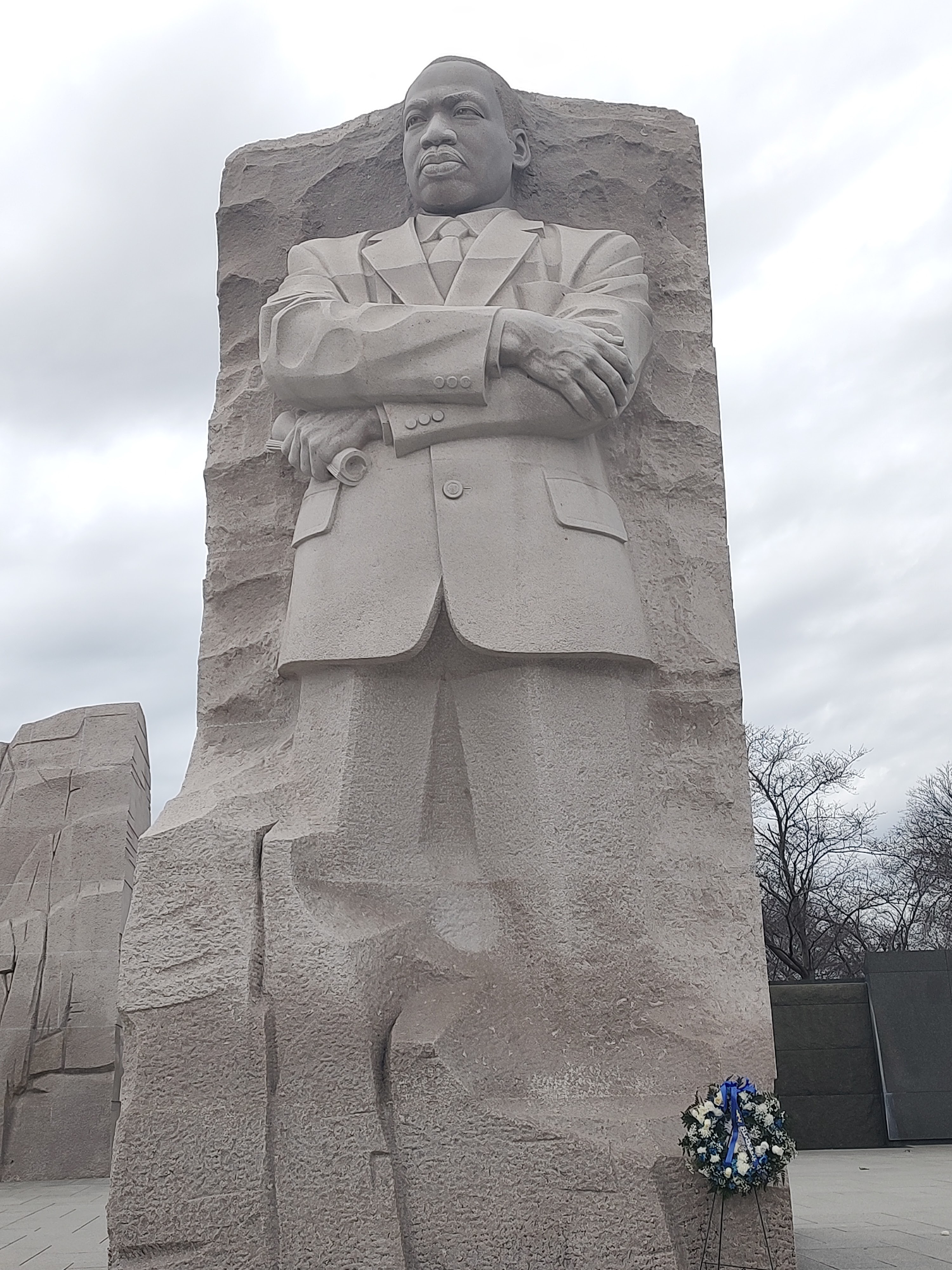
Before leaving Washington, D.C., a place that used be known as a sort of “Black Mecca” before Atlanta took first place, I took a long walk on the United States National Mall and stood silently for a moment in front of the monument as my 2024 tribute to Dr. Martin Luther King, Jr. I love that the sculptor gave Dr. King strong African physical features and expression – and that he emerges from the rock or the earth – even as he is wearing a suit, which is fashion or style created as an expression of white, European culture.

This April 2024, it will be fifty-six years since the assassination of the Rev. Dr. Martin Luther King, Jr., and as I stood there feeling the power of his image and the look on his face (pictured above), deep in my heart – or maybe it was coming from my Spotify playlist – I heard the lyrics to the song, “Risin’ to the Top.”

Risin’ to the Top, originally performed in 1988 by Keni Burke, was a jam that I definitely grooved to when I was an undergraduate student pursuing a degree in Political Science at the former Clark College, which was soon to be Clark Atlanta University. It has been sampled by quite a few musical artists, in particular Mary J. Blige.

Today, when I look around and see so many hateful, materialistic, and selfish black men and women operating in ways that tear themselves and others down, and making choices that keep them from experiencing happiness, it saddens me (and sometimes it rightly angers me). Is this us? Collectively, is this who we have become: devaluing and holding blackness in contempt like our oppressors did to our ancestors?

No, on this trip to Chocolate City, when I had the chance to talk with these beautiful black people and to perhaps make some new friends who are living out their lives with dedication to building themselves up and helping people in need, I was truly INSPIRED and once again proud to be who I am: A BLACK WOMAN.

Thank you, beautiful black people for reminding me and all of us of who we are, and of how important it is to “keep rising to the top, giving all we’ve got!”

Here, at the top, is where we definitely belong.

© 2024 annalise fonza, Ph.D., MURP, M.Div., MPA, BA

Updated 03/03/2025

Not Without Intimacy: Black Women & the Power of Relationship

Back in 2023, I was in conversation with a coworker about what it is like to be dating at 50 and over. This subject also came up when one of my students asked me about my relationship status. Actually, I should say that we were talking about what it is like to be open to dating at 50 and older because it is now quite rare that I genuinely want to be with a man for the purpose of intimacy. On the other hand, this does not mean that I am without intimacy in my life because intimacy is not something that is limited to nor is it dependent upon the men in my life. In fact, there are many ways to experience intimacy in this amazing, wonderful life!

In order for me to desire intimacy with a man there has to be reciprocity. Unfortunately, many of my former and would-be male partners failed repeatedly to be “reciprocitious” in their day-to-day interactions with me. The inability to offer reciprocity, which is a significant part of expressing emotional maturity, as far as I am concerned, is a deal-breaker (and please note that I am not using the terms intimacy and sex interchangeably). In other words, a one-way relationship is out of question. For me to embrace a relationship as worthwhile, both of us must have the ability and willingness to give and receive. Any man who demonstrates that he has nothing to offer; that he is unable to give of his authentic self (not the same as his money, possessions, or power/positions in life); and that he is unwilling to receive unilateral gifts of love and affection from me will disqualify himself as a potential or long-term partner. 

Frankly, it has come down to this: I will not spend my time nor my person with a man who is unable or unwilling to articulate and present his authentic self to me. Sadly, there are many men over the age of 50 who are in this predicament. In fact, there are many men who have absolutely no clue what the term “authentic self” actually means because patriarchy teaches them to be the exact opposite of authentic. Patriarchy, which is not the same as masculinity, is an ideological assertion that teaches boys and men to be impostors and to lie, steal, and take to get what they want, including taking the approval from other men that is gained at the expense of girls or women.

Much to my dismay, I personally know quite a few men over the age of 50 who approach relationship and intimacy from a patriarchal standpoint and as if they were 35 years old or less, again (e.g., they exhibit signs of arrested development). One of the most disappointing expressions of patriarchy for me, for example, was hearing a man brag about how many women that he had sex with throughout his lifetime – as if having sex with women was an important contribution to society.  Apparently what is between his legs was something that gave him a sense of value or importance. This was very troubling for me to digest for  obvious reasons. Furthermore, I am much more interested in what is in a man’s head than any other part of his body.

Not too long ago, for example, I heard from a man who knew me as an adolescent and who admitted to perpetuating a lie that one of his friends spread about me that benefited him in his social circle, yet it was a lie that was told – unbeknownst to me – at my expense. Ironically, the person who told the lie is now dead. Not that it matters to me today, because none of these former adolescent acquaintances has a significant place in my life today, but I share it to illustrate how the toxicity of patriarchal behavior that is articulated in adolescence may continue to be a reality that follows one into in adulthood.

I am also aware that many of the adult men that I could or would date may be currently struggling  with mid-life issues, such as declining health, overwhelming feelings of regret or missed opportunities, or disappointment in the inevitable change in outer body appearance or physical (including sexual) ability. Nevertheless, if they do not intentionally resist patriarchy, then they too will be prone to repeat and perpetuate the destructive personal and social patriarchal patterns and the consequences that go along with it. It is a vicious cycle that some will never muster the courage to confront or break. However, if they do not break these toxic, patriarchal attitudes and cycles, I regret to say that their lives will not be much different than the ones who taught them to behave this way. Indeed, it is insane – and troubling to me – that they apparently want to keep living like this!

Given the childish/narcissistic behavior of many of the men that I know, I tend to assume that they secretly long for the return to their adolescent and young adult selves. After years of tolerating patriarchal treatment that was filled with rounds of the silent treatment; emotional abandonment; emotionally abusive behavior; angry outbursts; irrational hostilities directed at me simply because I expressed a different opinion or challenged their way of thinking; unilateral attempts to control the thermostat or anything attached to the maintenance of the apartment or house; lying (usually by omission); accusations that I was cheating because what I was wearing looked “too good” for just me or everyday attire; drunken as in intoxicated) rants and thus unpredictable behavior; constant criticisms about my choice in movies or other personal interests that I embraced; and other unbelievably childish incidents that I am simply too embarrassed to repeat.

Thank goodness, I finally decided that it was useless to spend even five minutes with any man who does not have the slightest idea of how to regulate his emotions or be in a healthy, dynamic relationship with an intimate partner.

I know that I can do much better, or I could just be with myself because I like spending time with me! Frankly, I cannot believe that I stayed as long as I did with such emotionally bankrupt men as long as I did in the past, but I am super glad that I was finally able to give up on men who apparently are not prepared for a balanced, healthy relationship. I have better things to do with my time than be with someone who will try to treat me as if I am an idiot, or as if I would not be able to see through all the emotionally abusive games that these men play.

Because of these encounters with men, I have learned many lessons, but one of the greatest is this: it is a total waste of my time to spend any serious amount of time with a man who is, at best, emotionally immature and has not accepted his own evolutionary process. The behaviors of a man who is  clueless about his emotional maturity (or lack thereof) are simply unacceptable; and – therefore – emotionally immature men are unacceptable! At this point in time, emotionally immature men are not even worth it to me; furthermore, they vex me and they are hazardous to my health and well-being. Indeed, I am attracted to a man for what is on the outside, but what is on the inside, in terms of his emotional maturity or intelligence, is far more valuable to me in the long run, and that is what I pay close attention to when a man shows any romantic interest in me.

This means, for example, that I observe how a man speaks to me about women and women’s issues in general (such as leadership, employment, and reproductive rights); how he handles the unexpected ups and downs in his life; and, how he plans for his own self-care and personal growth and advancement, including the upkeep of his physical and mental health. If a man who is interested in me is only satisfied with the mediocre in his life, then I am definitely not the one for him.

Here is the thing:

My standard is excellence, not mediocrity, and if a man is romantically interested in me he will have to earn the privilege of being with me. I will no longer assume that a man has the ability to be emotionally present to me just because he shows interest in me. He will have to demonstrate that he has what it takes to sustain a healthy, loving relationship.

In some circles, it is well understood that out of all groups of women, black women are often the least chosen for the purpose of marriage. In fact, I know quite a few black women over the age of 50 – even over the age of 70 –  and they live their lives alone, without a marital partner. To support this realization, author Ralph Richard Banks writes that “black women are three times as likely as white women to never marry.” This is truly a conundrum to me because 1) black women are one of the most productive groups in this country and 2) we are one of the most educated groups of women in the U.S. Yet, when it comes to marriage we are glaringly alone. Of course, I am biased, but black women are some of the most resilient, bravest people that I happen to know, so I get it that it is disappointing for some to see so many beautiful black women living their lives alone.

However, to the whole idea of being alone I must say, SO WHAT? Being alone does not mean that we are without intimacy, or companionship, or fulfillment in life; and, frankly I am not in competition with white women or any other woman about marriage. The fact that black women are perhaps the least likely to be married as other women is not necessarily a bad thing. There are lots of issues that factor into this social phenomenon, including the incarceration or death of a partner or spouse, particularly as it pertains to the disproportionate jailing of black men. Given these factors and the complexity of social realities facing black women, there is absolutely nothing wrong or shameful about being alone. In some cases, choosing to stay single might be the better choice.

If I were to offer a hypothesis (from the perspective of a social scientist), I believe that today’s status of cis-gender hetero black women may suggest that they are quietly dismantling and transcending the construct of marriage as it is articulated in Western American culture. In other words, perhaps marriage in the Western sense is not truly working out for black women, but this is not due to any fault of their own, nor should we accept any blame for what is happening socially. Many black women are rejecting marriage and traditional relationship frameworks, including childbearing, because of patriarchy and the oppressiveness thereof. Consequently, in response they are consciously choosing to stay single and they are happy with that choice (and thanks to the sacrifices of many women who went before us, we can do that!).

Think of it this way: there are many black women who are not willing to put up with the patriarchal crap that their predecessors may have been forced to put up with due to racism (also perpetuated by white women), white supremacy, and blatant forms of gender and employment discrimination. Today, we too have options and we are not limited to one group of men, nor American men for that matter. For a good read on the subject of black women navigating relationships on their own terms, I recommend, No Thanks: Black, Female, and Living in the Martyr-Free Zone,  a book by Keturah Kendrick.

For many black women, like me, marriage is not completely off the table, but I do know that many of us are simply over the hype of marriage as a marker of success. Thankfully, some of us have finally come to the realization that we do not need marriage to make us who we are or anything. We are just fine without marriage or a spouse “to make us whole,” thank you very much! We are already whole – or complete – and to assert that black women need marriage to make us this or that is quite frankly sexist and comes out of a place and a way of thinking that women (at the least) should have let go of a long time ago.

For example, the idea of marriage in the Bible is rooted in polygamy, not monogamy. Can you identify one man in the Old Testament, for example, that did not have or feel entitled to more than one wife? Unfortunately, there are many men and women who formulate their ideas about marriage and women’s rights from this ancient book, which is one reason why I would not follow many of the men that I meet or know down the block, let alone into marriage – and definitely not if they are regularly use lies and manipulative behavior to get something from women, which is all too common these days.

If a man believes in the marriage of the Bible and if he takes the Bible literally (via the Old or New Testament), then he is not for me. Many of the men that I know who take the Bible literally about marriage do not take the Bible literally in other aspects of their lives, especially as it pertains to their familial, social, sexual, eating, and drinking habits (in other words they do and say many things that would be considered sin or “abomination” according to the Bible). Men who do this are hypocrites to me, not to mention they pick and choose parts of the Bible to serve their own interests. I will not make any space or time for a man in my life who is into “cherry-picking” the Bible, whether intentionally or not. This is a sign of self-centeredness.

There are other reasons that I do not use the Bible or other scriptural texts to organize my life and one of them is that rarely are the stories in the Bible genuinely concerned about the lives of women. In my scholarly opinion, I would like to propose that the Bible is a book that was written by men for men (and I am definitely not the first woman to make this proposal). But, no need to rely on opinion: can we point to any women who were a part of the Council of Nicaea in the fourth century??? Likewise, we do not know much about Mary the mother of Jesus beyond Jesus; but as it pertains to the literary record it is not a stretch to say that Mary’s primary function was to produce a son. Or, let me put it like this: she exists in the Bible only in relationship to her child; not as an autonomous biblical figure with a mission of her own.

Similarly, other women in the Bible, starting with Eve, are represented as problematic or tempestuous to the men around them; this idea has been foundational for most if not all of the Abrahamic religions from the start. In short, I will say that the biblical depiction of women is very problematic, and I refuse to redeem it or give it more credibility than it deserves. In addition, if I have said it once I have said it a thousand times: the Bible is not a history book – it is a book of faith, rooted in the lives of a specific group of people that lived more than 2,000 years ago. It is no secret that books of faith are often not historically accurate.

That said, I do not and will not appropriate the book that is called the Bible to order the events of my life, nor do I use it to make sense of life in general. Be my guest if you wish to give the Bible this kind of prominence in your life, but I simply cannot justify making such an outdated and patriarchal book the blueprint for my life. On the other hand, if the Bible teaches me anything it is what I do not want, and there is no doubt whatsoever in my mind that my life does not have to be rooted in what it has to offer as a non-chronological and non-sequential collection of writings.

The Bible’s prescriptions for my relationship to men and marriage are frankly not even relevant to me. These texts, written over two millennia ago, how could they be? The authors of this collection of texts could NEVER have imagined me or my life, personally or culturally speaking. Today, I can live a good, healthy life without marriage, and when it comes to male companionship or partnership, I can take it or leave it. I have the means and the ability to provide for myself, and there is no way on this blue and green Earth that I would spend the rest of my life with a man if his views on gender, womanhood, and even marriage are based on male superiority and thus female inferiority that is rooted in “another time and another place” (in the words of Abbey Lincoln).

For crying out loud, in the twenty-first century, there is so much more that I can use to “order my steps” in this amazing world of ours (pun intended). At this point in time, for instance, I tend to connect more readily with Buddhist philosophy than I do with Christian philosophy because the notions of balance and mindfulness are foundational to my well-being, inside and out. To be sure, it is one of my aspirations to live a balanced life: finding the balance between work, life, and my personal relationships is key to good mental and physical health.

Dating as it exists today is one of the scariest endeavors that I have even had to negotiate: addiction plagues a lot of the eligible men that I know and online dating sites are full of narcissists and people trying to manipulate women for all kinds of things, including sex, money, attention, etc. Yes, I know that women engage in their share of using others for personal gain, but it is nowhere near the things that men have done historically to hurt women and children: the biggest predators and sexual offenders in our society are men not women. If an example is needed, just take a look at the history of the Catholic Church.

On the other hand, it is not hard to recognize toxic patriarchy; all you have to do is pay attention to what a man says because usually he exposes himself. For instance, a man that I know once tried to tell me that a woman that he used to date calls him from time to time to tell him that she hates him. Really? Why would a person who hates you call you? More than likely, he was the one calling her.

I approach dating like I approach securing my living space and my computer: with great caution and vigilance. But, there are many ways in which black women as a group of people experience intimacy and thus familiar, warm bonds with others. As a group, I know first-hand that black women engage in many activities that bring them a sense of purpose and intimacy. In some cases, we approach our work in relational and collaborative terms, and we connect with those in our professional and personal circles with great familiarity and fondness. Indeed, black women will develop special bonds with friends and perhaps with lovers, even if those bonds must be modified to reflect contemporary, twenty-first century considerations and the hypervigilance that we have to exercise just to be physically  and emotionally safe in a world that often seems to be spinning out of control with toxicity and increasing me-me-me attitudes.

As far as I am concerned, the most important relationship that I will ever have is with myself. I would choose to be with myself a thousand times over being in an intimate relationship or married to a hypocrite and feeling pressured to relinquish or negate the special, intimate relationship that I have with myself. I have places to go, people to see, and things to do, and marriage is not going to keep me from doing those things. If I ever do get married, the marriage and the man will empower me to be my best self and to reach my goals, for myself.

When I first had this conversation about intimacy with my coworker – who is a black woman – I promised her that I would write something about black women and intimacy, and I honored that promise because it has to be said that black women are not victimized, nor are we diminished by the fact that more of us are not in marriage vis a vis any other women’s racial ethnic group – and everyone on the Earth comes from an ethnic group. Furthermore, do the math: the success of marriage in the United States is not all that impressive (it is only at 50%), thus being or staying single well into one’s adulthood is apparently a very wise thing to do.

Let us face it: when it comes to the “institution” of marriage, we cannot keep doing the same thing and expect to get different results: this is insanity. For the time being, I have no interest in getting married, but, to be clear, I am not without intimacy in my life, nor do I want for attention. I am not alone all the time, but when I am alone, I welcome it because solitude gives me a sense of self and “ground of being” that no one else can provide.

No doubt, black women have demonstrated, time after time, that how we spend our time and our talents as it pertains to marriage may be exactly what other women need to see to stay single longer. If you ask me, we are the vanguard as it pertains to the pursuit (or not) of marriage, and our lead is quite remarkable notwithstanding what people (including black men) constantly do to try to put us down or make us seem lacking. We are not the victims here at all.

In closing, I must say that black women are perfectly capable of demonstrating what intimacy can look like with a conscious and steady dedication to ourselves and our loved ones, marriage, or not. The example that we have set is one of the realities that makes us who we are in social, personal and political terms, and it fills our lives with love and meaning, regardless of what others say or think about us. Nothing could be more powerful and purposeful than living a life that is intentionally and authentically connected to self and others and this is one reason that everyday, I am proud of who I am: a totally capable, ethical, beautiful, responsible, serious, and loving black woman.

© 2023 annalise fonza, Ph.D., MURP, M.Div., MPA

Updated 07/21/2025
On the Spelling of My Name and the Seeds of Change

I have been spelling my name in lowercase letters for at least a decade; come to think about it, it has probably been closer to two decades than it is to one. All these years, embracing the spelling of my name has been my signature, my trademark. Looking back, I was first inspired to modify the spelling and thus the visualization of my name on papers and publications to lowercase letters because of bell hooks. Her critical thoughts and writings on feminism, love, men, power and many other issues had such a profound impact upon me that I decided to put my newly recognized consciousness out in public – and as a passive but powerful way of identifying with feminism as a way of thinking and being. At the time, I must admit, I really did not realize the power of what I was doing.

Recently, I was “advised” by someone associated with an academic organization that I needed to use the uppercase A and the uppercase F if I anticipated my name being publicized or in print. This directive, made by a white woman (who I knew formerly and casually) did not sit well with me. And that it came via email didn’t help matters either. Initially, I thought, was this advice or a threat? I wondered why she felt the need to tell me what to do with my own name. And, I wondered what was coming next. Maybe, I imagined, she would feel familiar or superior enough to me to tell me what to wear or where to sit. Since she knew of me from academic circles, it baffled me that she needed or wanted to tell me what to do with my own name; as if somehow she thought that I did not know. Of course, I responded to her just as boldly and confidently as she came to me, but I also thought that perhaps it is time for a blog on the spelling of my name, just in case others were having similar thoughts or urges.

First, the spelling of my name is mine, all mine. I don’t expect others to use lowercase letters to spell my name. But, every chance that I get to control the look (and feel) of my name, I use lowercase letters. One of the first public experiences that I had with this was in Springfield, Massachusetts. I had just given a lecture at what is now the Lyman and Merrie Wood Museum of Springfield History and a local newspaper reporter asked me how to spell my name. In addition to getting the spelling correct, I also asked if the “A” and the “F” could be written in lowercase. Much to my surprise, and at least for that particular local journalist, using lowercase letters was not a problem, and so he published it as I requested. Seeing my name published in the local newspaper the next day in lowercase letters was very important and very powerful. It was an affirmation of my own identity, and it was a declaration, one that let other people know – in a very public or political way – that the spelling of my name was and is ultimately up to me.

Aside from the”bell hooksian” influence on the spelling of my name, there are a few reasons that I have continued to spell my name in lowercase letters. The first is that spelling my name in lowercase letter is a visual reminder to me of all the seemingly insignificant things that I did in life to get to where I am today. By no means do I think that I have done all that I can do, but I have accomplished a lot. I have also had the awesome privilege of traveling alone in and out of this country and taking charge of my own future or destiny. Sometimes, when I look back at those little things, including the places where I lived or worked, I am blown away. I have been through many ups, downs, stops and starts, and, of course, I did not get there all alone, but seeing my name in smallcase letters always brings me to a deeper appreciation  of my life’s journey and of the power that I have because of that journey.

Another reason that I spell my name in lowercase letters is related to the connection between the personal and the political. The more that I spelled my name in lowercase letters in print, the more that I was asked about the spelling of my name. Who knew that such a small thing could have such an impact! Consequently, the (re)spelling of my name brought me to the realization that even the smallest change to the social order of things or the status quo is always noticed. Indeed, I know how to construct a grammatically correct sentence. I know that breaking the rules with the spelling my name in all lowercase letters will be seen by many as incorrect, improper, and perhaps, need I say, DISOBEDIENT! And that is it precisely. Spelling my name in lowercase letters is a type of stand or attitude; it is a personal manifesto that speaks to popular thinking about women and identity. Spelling my name the way that I want to spell it is simply a way of accepting and loving myself. But, it is also my way of letting people know that I am not a follower, although I am totally capable of collaborating with others on various projects and programs. I don’t always need to be out front and in charge, but I have always been a leader. I have always been womanish in attitude and expression, or, as Alice Walker says about womanism; a womanist is “serious and in charge!” Others may disagree with me or reject the spelling that I give my name, and they may make it “proper” for personal or institutional purposes, but at the end of the day, I am in charge of my life, my actions, my body, and, of course, I am in charge of saying or determining who I am. How I spell my name is up to me, alone. Yes, it may seem like such a small or unnecessary thing to say, but control over my name, the power to name myself and thus to know myself is a powerful freedom, and I take that freedom very seriously, just as other black women, like Audre Lorde, have done without shame and without apology.

Most people don’t break the rules. We live in a society where conformity is the name of the game. People keep the peace; on the job and beyond, they often engage in groupthink and peacemaking. Even with all that women and men have been through, especially black women, by and large, people don’t “rock the boat.” Spelling my name in lowercase letters is a passive yet strong way of saying that I am not afraid to break the rules. I am not afraid to walk down a new path if necessary. When I look at people who cling to the rules without a willingness to question them or perhaps change them, I see followers. This is both sad and disappointing situation because a great many of the rules, laws and practices that govern us actually need to be changed or broken. Many of the rules that dictate our living and our being, at the least, need to be challenged, or at least questioned. When people express a desire to control how I spell my name, it lets me know that they are probably not willing to make a change, not even in the small matters of their own lives. And, if they are not willing to start with changing self, I doubt very seriously if they will be willing to challenge the order of things when it comes to bigger matters, such as sexism, such as racism, such as heterosexism. When people do not model change or plant the seeds of change when it comes to their own affairs, it is doubtful that they will do it for others.

I should not have to say this, but one of the things that the world  desperately needs is people who really are willing to be the agents of change. The world needs bold, brave change agents, not the so-called change agents or change makers who merely appropriate the rhetoric or talk of change during election season in order to get votes. Today, many are appropriating the word “change-agent” or “change-maker,” but there is little doubt in my mind that many of those very same people would also be the first ones to tell me or others to “go along to get along” if they could. If they could get away with it, I believe they would tell me and others – the ones they may attempt to control –  to know and stay “in our “place.” Yet, the place they want others to stay in is often the place that makes them comfortable or secure in life. And, what they tell others to do is often a reflection of their own self-esteem or self-image: stuck.

By contrast, I don’t require others to spell my name in lowercase letters, but I don’t let others tell me what to do or how to spell my name so that they will feel better about themselves or what it says about their day to day choices. Fortunately, we live in a country that allegedly values “the freedom of speech.” And, that freedom applies to the spelling of one’s name. I feel free to model that freedom to name myself in my personal and in my public life, which are very interconnected. In the (re)spelling of my name I also model what it means to be in control and accountable for who I am.

Last month I watched the politicians and pundits claim to be the agents or makers of change. Yet, I don’t see how they are much different from who or what has gone before them. To be an agent of change you’ve got to be willing to change yourself. If you are not willing to change, if you don’t know the power of changing things on your own, how in the world can you expect or require change from anybody else? And, if you are quick to tell others where to go, what to do and what to do when they get there, then I doubt that you will allow yourself to get out of place for a worthy cause (and perhaps not even for an unworthy cause). These days, there’s a whole lot of talk about change, but that talk is often just what it is: talk.

Oh how I wish that more people would be willing to break the rules and get out of the places that people and society have constructed for them to be. I long to see people who lead and from a place inside of them that is authentic and thus political (or socially responsible). Donald Trump, for example, is the antithesis of authenticity and accountability. He uses the rhetoric of change yet promotes the ideas and nostalgia of a troubled American past. What former greatness does he want to revive or replicate? Yes, there were times in my past that I was pretty good, but the person that I have become today is much better, stronger and confident. There is actually no part of my past to which I would like to return. Indeed, I look back and I learn, but life is moving forward, not backward. My being who I am today is based on my ability to grow and  learn from my past mistakes and successes; yearning for something that I once did, for the person I once was, or for the life I once experienced would indicate to me that there is some preoccupation or unfinished business that I have with regard to my past. Perhaps, in some weird, twisted kind-of-way those who want to go back and revive the past, like Trump and his followers, really are preoccupied by something that is back there. Clearly, for better or for worse, they have some preoccupation or attachment to the persons, places or things of the past that they remember. Maybe they want to fix something that was broken in the past; or, perhaps they want to repair some damage that was done in the past, or maybe they have regrets. As far as I am concerned, I cannot fix the past; no one can. But, what I do with the present and what happens in the future depends on my ability to interpret the past accurately and then to plant the seeds of change that will bring forth powerful and better futures.

To the would-be and rising change agents out there, I must say that you cannot bring forth better futures if you keep looking back, longing for what was once there. To feel the power of change, to be a powerful agent of change, you have to be willing to break  the rules, to cross lines and usually that means you will be in the minority and perhaps alone. Don’t be fooled by those who merely talk about change, because to be a  true change-agent or a change-maker you’ve got to be willing to be in a new place, not the old. Indeed, it is not easy being in a new place, or being in the minority. But please know that today, more than ever, if we are going to create powerful and better futures, we desperately need those who are bold enough and brave enough to spell their own names.

© 2016 annalise fonza, Ph.D.

Black Women, Atheist Activism and Human Rights Is Now Published!

Just found out that my latest journal article, “Black Women, Atheist Activism and Human Rights: Why We Just Cannot Seem to Keep it to Ourselves!” is now published and available in Crosscurrents, which you can find at http://onlinelibrary.wiley.com/doi/10.1111/cros.2013.63.issue-2/issuetoc. If you are not able to access the journal free of charge and you would like a copy, please contact me directly via message and I may be able to help. If you have access to academic databases, or if you are a member of a local library (that may, in fact, have online access to this journal), my article was published in the June 2013 issue, Vol. 63, Issue 2, pp. 185-197. I am so excited! It is not easy for an atheist to publish in a journal that is dedicated to religious thought, and this is my third academic publication since December 2012! Looking back, I doubt that I could have done this had I been teaching full-time at Clark Atlanta University (as I was during the first half of 2012). Well, suffice it to say that sometimes it pays to jump ship when it is clear that the ship is gonna sink. Just saying 😉